
Why Social Media Strategy in Japan Fails for Foreign Brands
 JD_ADMIN
Entering Japan takes more than just translating your content. It requires a complete strategy shift.
Japan's digital world operates on its own unique set of rules, often defying global trends. What works in New York or London rarely works here. To succeed, looking at user numbers isn't enough. You need to understand the "psychology" behind them. Especially, why is X so common compared to other countries?
This guide breaks down the real usage of Japanese social media in 2026, backed by local case studies that prove how cultural context drives revenue.
The 2026 popular social media apps in Japan
According to the latest 2025 data from Values, Inc., the ranking of popular social media platforms in Japan still differs from that in Europe and the US.
The current breakdown of monthly active users (MAU) is as follows:
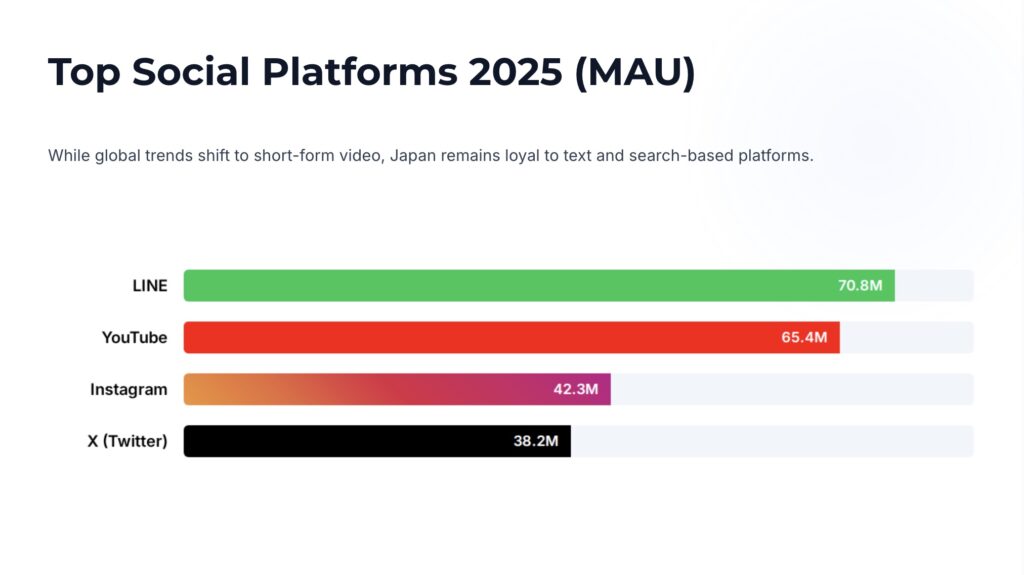
LINE (70.8 million)
Japan's equivalent to WhatsApp, but with deeper business integration. Almost everyone in Japan uses LINE for daily communication. Unlike WhatsApp, users frequently add "Official Accounts" of their favorite brands to receive updates and promotions, functioning much like an email subscription within a chat app.
YouTube (65.4 million)
Usage trends here are nearly identical to the US and Europe.
It serves as a hub for both search-driven long-form content and, increasingly, Shorts. Unlike LINE or X, which have unique local cultures, YouTube is used in Japan just as it is globally-as a primary source of entertainment and information for all generations.
Instagram (42.3 million)
Instagram (42.3 million) The interface is standard, but the user journey is distinct. Especially among younger generations, Instagram is the first step in the search process for food, fashion, and travel. They decide "what to buy" here, and only use Google afterwards to confirm details (like maps or official specs).
While a polished, catalog-style profile is the global standard, that alone is rarely enough to sell in Japan-especially for unknown online-only brands. Japan is a low-trust market for new entrants.
The unique winning strategy here is "Showing Weakness" While global brands tend to showcase perfection, successful Japanese D2C brands often expose their "Process"-including struggles, regrets, and failures in product development. This raw honesty triggers a psychology of "Oen" (support), turning customers into fans who buy the product to support the founder's journey.
X (Twitter: 38.2 million)
Japan is an outlier. While X has seen fluctuations globally, it remains a dominant platform here.
The key difference is the culture of anonymity. Unlike the "real-name" culture of Facebook or LinkedIn, Japanese users prefer X to express their honest opinions (Honne) without social pressure.
For marketers, this makes X the primary source for real-time news and unfiltered consumer feedback, rather than just a place for brand announcements.
Two Japanese social media success stories
You don't need a big budget to make social media go viral in Japan. The key to success lies in giving your brand a “human touch” and mastering an “in-house” tone.
1. I-Wrap (@i_wrap_official): A Model of Fan Engagement
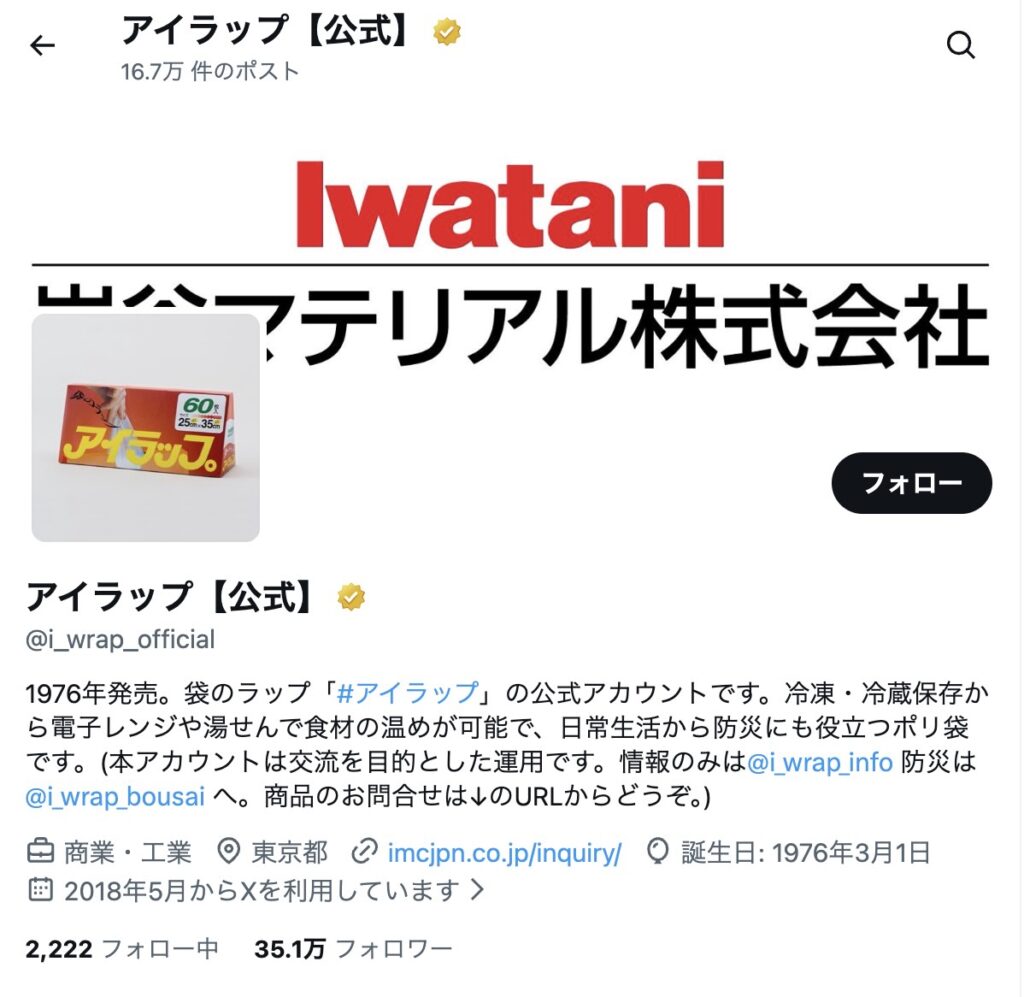
Iwatani Materials' simple plastic bag “I-Wrap” gained nationwide recognition through X.
Rather than corporate advertising, the account manager's strategy involved picking up niche usage examples from everyday conversations with users.
By leveraging user-generated content (UGC), this everyday item transformed into a cult-favorite product.
It might look text-heavy and not very stylish, but beautiful designs don't always sell. Especially in Japan, information-dense layouts often perform better.
2. Hokuoh Kurashi (@hokuoh_kurashi) : Selling a "Worldview"
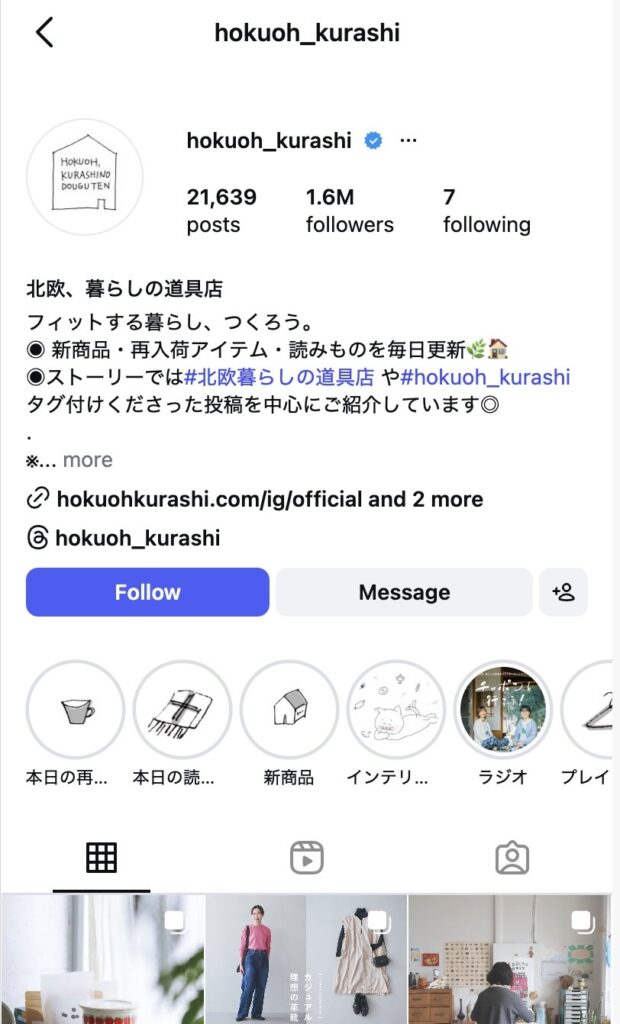
Hokuoh Kurashi is a prime example of content-driven e-commerce in Japan. Its defining feature is selling a “worldview,” not just products.
Its Instagram feed is meticulously curated to resemble a lifestyle magazine. By consistently providing aesthetic content matching the lifestyles customers admire, it has established a loyal fanbase eager to purchase products to “complete” the world depicted in the feed.
This strategy proves that branding in Japan is not merely about practicality, but fundamentally about selling a storytelling experience.
The Key to Engagement: Understanding User Behavior in Japan
To succeed in Japan, you need to understand how users interact with these platforms. It differs significantly from the West in two major ways.
The Culture of "Multiple Personas"
Unlike the Western norm of "One Person, One Identity," Japanese users are masters of maintaining multiple accounts across Social Media (especially X and Instagram).
It is common for a single user to have separate accounts for different facets of their life: one for work, one for real-life friends, and specific accounts strictly for hobbies (like anime, camping, or cosmetics).
Why does this matter for marketing?
This behavior makes X an incredibly powerful tool in Japan. Because users segregate their interests, the platform's algorithms are highly optimized. When a user is logged into their "Hobby Account," they interact only with that specific topic. This signals clear intent to the algorithm, allowing brands to reach audiences with much higher precision.
High-Context Communication: Read between the lines in Japan
Japanese users like “reading the air” (Kuuki wo yomu). In this high-context culture, what is left unsaid is often as significant as the words on the screen. Successful brands avoid the "Hard Sell" approach, which is often perceived as intrusive or "noisy" (Uzai).
Instead, the most effective strategy is to provide content that cultivates empathy (Kyokan). This means blending into users' daily timelines through helpful tips, seasonal greetings, or self-deprecating humor. Such approaches indicate that the brand understands the subtle nuances of everyday life in Japan.
By demonstrating an ability to “read the air,” brands get respect and loyalty never achievable through direct advertising. For example, this includes adjusting tone during socially sensitive periods regarding a specific topic or holidays.
Social media marketing in Japan is not a monologue from companies. It is a quiet dialogue based on shared values and mutual understanding.
The Key to Success: Strategic Platform Selection
You don't need to be on every platform. You just need to be on the right one. For some brands, a perfect Instagram feed is necessary. For others, simply showing your "weak points" or honest struggles on X can win more fans than a high-budget campaign.
At JDOC Inc, we build strategies based on what actually fits your business type and budget.
Here is a recent success story: We supported a restaurant run by a foreign owner in Japan. Instead of wasting their budget on expensive video production, we built a strategy focused on X (Twitter).
As a result, without shooting a single professional video, we achieved over 1 million impressions and consistent engagement.
**X Analytics**
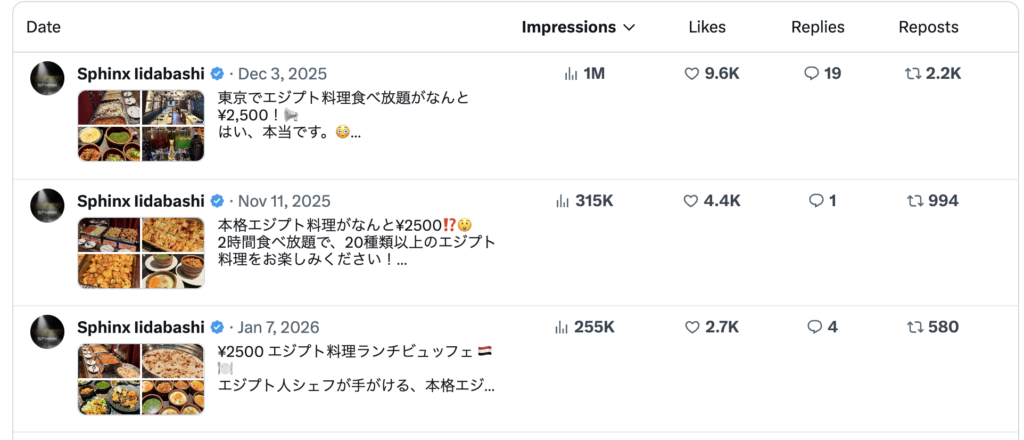
Most importantly, this digital buzz translated into real foot traffic, significantly increasing their sales compared to the previous year.
The "Lost in Translation" Trap
We specialize in tailored social media strategies and ad operations for your specific product. But our biggest strength isn't just marketing tools-it’s communication.
When hiring a Japanese social media agency, you typically face a language barrier. This forces you to rely on professional translators.
In this case, most translators are experts in language, not marketing. They often fail to grasp the strategic nuances, leading to misunderstandings and failed campaigns.
We are different. At JDOC, the experts managing your social media speak English directly with you.
There is no middleman. No "broken telephone" game. You talk directly to a marketing pro who understands both your brand's vision and the Japanese market.
**Available in English, German, and Chinese. Of course, Japanese too**
If you want to avoid miscommunication and ensure your strategy lands correctly in Japan, let's talk.