
Influencer Marketing in Japan: When #PR Is Required and How Content Can Be Reused
For overseas brands, influencer marketing in Japan often becomes complicated in two places: deciding when a creator’s post needs to be identified as advertising, and understanding what the brand can do with that content afterward.
A straightforward paid collaboration is easy to recognize. Gifting is less clear. A brand may send a product with no posting obligation, ask a creator to share it if they like it, or provide detailed instructions without paying a cash fee.
Since October 1, 2023, stealth marketing has been regulated in Japan under the Act against Unjustifiable Premiums and Misleading Representations, commonly called the Premiums and Representations Act.
Put simply, stealth marketing is advertising that looks like an independent recommendation or ordinary consumer opinion because the commercial relationship behind it is not sufficiently clear. An influencer appearing to recommend a product on their own initiative when the brand was actually behind the content is one example.
For overseas brands, the important point is that a free product does not automatically make a post advertising, but the absence of payment does not automatically make it organic either. The circumstances behind the relationship matter.
There is a second issue that often appears only after a campaign performs well. A creator’s post may suddenly be useful for paid advertising, ecommerce, retail, or a regional campaign. In Japan, these additional uses are often discussed as secondary usage (二次利用, niji riyō) and may need to be negotiated separately.
For a broader overview of creator selection, platforms, costs, and campaign management, see JDOC’s guide to working with Japanese influencers.
When Is Influencer Disclosure Required in Japan?
What Determines Whether Disclosure Is Needed?
Japan’s Consumer Affairs Agency (CAA) focuses on whether a business was involved in determining content that consumers may otherwise take to be an independent opinion.
Under the stealth marketing provision, the regulated party is generally the advertiser supplying the relevant product or service. Disclosure therefore needs to be considered by the brand as part of campaign planning, rather than left entirely to the creator.
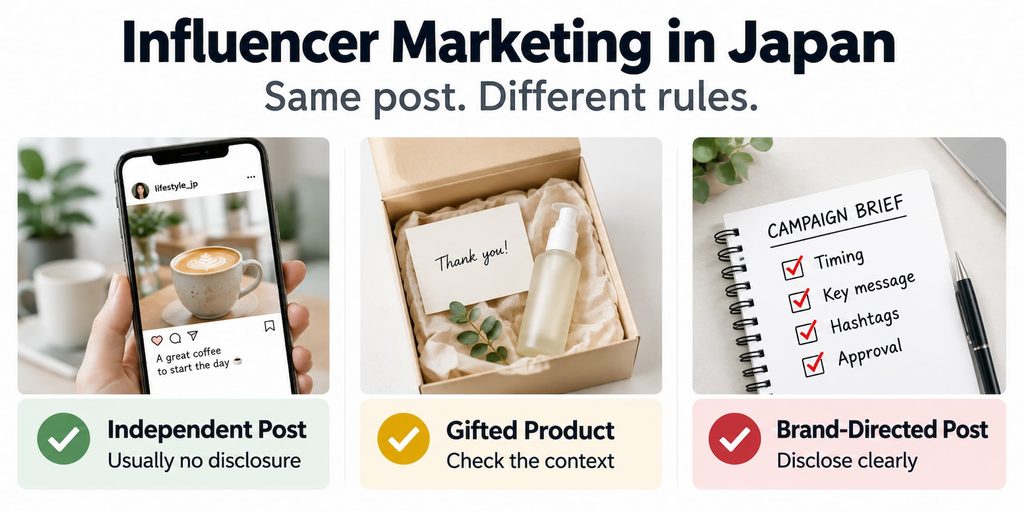
The following overview can be used as a practical first check when planning influencer activity in Japan. It is not a substitute for assessing the individual circumstances, but it helps show where the main differences lie.
| Situation | Practical approach |
|---|---|
| Creator buys a product independently and posts without brand involvement | Normally no advertising disclosure is needed |
| Brand sends a product but does not request a post or influence the content | Not automatically advertising |
| Brand sends a product and says “post if you like” | Grey area — review the wider relationship |
| Brand requests a post and specifies timing, messaging, hashtags, or approval | Generally treat as sponsored and disclose |
| Creator is paid in return for publishing content | Treat as sponsored and disclose |
| Free stay, meal, trip, treatment, ticket, or other benefit is provided in return for agreed coverage | Treat as sponsored and disclose |
| Creator was already independently posting about the product before receiving it from the brand | May remain independent, depending on the circumstances |
The less obvious cases tend to involve gifting and product seeding.
Does Gifting Require #PR in Japan?
A Gifted Product Alone Does Not Decide the Answer
Not every gifted product automatically requires #PR.
The CAA specifically discusses a situation in which a company selects an influencer, provides a product free of charge, and says that they may post their impressions on social media if they wish.
The answer depends on the surrounding circumstances. Relevant factors can include why the product was provided, what the brand and creator discussed, whether the company influenced the content, previous commercial relationships, and the possibility of future business.
A brand that sends a skincare product with no posting requirement, deadline, required message, or approval process is in a different position from a brand that asks the creator to post during launch week, mention particular product features, use campaign hashtags, and submit the content for approval.
The more the brand determines how, when, or what the creator publishes, the stronger the case for treating the content as sponsored.
The Difficult Case: “Post If You Like”
Many influencer seeding campaigns sit somewhere between those two situations.
A cosmetics company may select a particular beauty creator, send a new serum, and say that it would be happy to see their impressions on Instagram if they like it.
There is no formal posting requirement and no cash payment. However, the relationship may still have a commercial context.
The creator may have previously worked with the brand, may reasonably expect future paid campaigns, or may understand that regularly featuring gifted products helps maintain the relationship. These circumstances can all be relevant.
This is why “no obligation to post” should not be treated as an automatic exemption.
The reverse can also be true. If a creator was already buying, using, and posting about a product independently before the company began providing it for free, the later gift does not automatically turn future posts into advertising. The creator’s existing behavior helps show that the interest was not created by the brand.
This distinction is also important strategically. Product seeding can still be valuable without turning every gift into a tightly controlled campaign. JDOC’s BOTANIST product gifting case study provides an example of how carefully selected hairstylists and fashion professionals helped build product visibility through trusted networks.
Is #PR Mandatory for Influencers in Japan?
The Exact Hashtag Is Not Required
Japanese law does not require the literal hashtag #PR.
What matters is whether consumers can clearly recognize when content represents the advertiser.
The CAA gives wording such as “advertisement,” “promotion,” and “PR” as examples. The relationship can also be stated directly.
For example:
Paid collaboration
English:PR | This post was created in partnership with ABC Beauty.
Japanese:PR|ABC Beautyとのタイアップ投稿です。
Product provided by the brand
English:ABC Beauty provided me with this product.
Japanese:ABC Beautyより商品をご提供いただきました。
The second type of wording can be particularly useful in gifting situations because it explains what the creator actually received.
The WOM Marketing Association of Japan (WOMJ) also recognizes wording that clearly describes the benefit provided by the company. Its guidance notes that PR is widely used in Japanese social media, while wording such as #gifting may not be sufficiently clear on its own.
Disclosure Should Be Easy to Notice
Placement matters as well.
On an Instagram Feed post or Reel, disclosure should be easy to notice rather than buried among hashtags. On Stories, it should appear clearly on the relevant frame.
On X, disclosure should be included in the original post rather than only in a reply. The CAA notes that users may see the original post without opening the replies.
For video, a short notice at the beginning may not always be enough if viewers can start watching partway through.
The format changes how disclosure should appear, but it does not change whether the underlying relationship is commercial.
Japanese Law and Platform Rules Can Produce Different Requirements
Brands also need to check the disclosure rules of the platform itself.
This matters because platform policies can be broader than the legal analysis under Japan’s stealth marketing rules.
For example, Instagram’s branded-content policy requires the Paid partnership label when there has been an exchange of value, and Meta explicitly includes free or loaned products within that definition. This means a gifted post may require Instagram’s platform label even where the question of whether the post constitutes an advertiser’s representation under Japanese law requires a more detailed assessment.
YouTube similarly requires creators to declare branded content through its Paid promotion setting when content has been influenced by a brand in exchange for something of value, including free products or services.
TikTok requires creators promoting a third-party brand in return for payment or another incentive to activate its content disclosure setting, which displays a Paid partnership label.
For overseas brands, the practical implication is that there can be two separate checks:
- Does Japanese law require the commercial relationship to be disclosed?
- Does the platform require its own branded-content or paid-partnership setting?
Meeting one requirement should not automatically be assumed to satisfy the other.
Is #PR Enough to Comply With Japanese Advertising Rules?
Disclosure Does Not Make Product Claims Automatically Acceptable
No. Disclosure and the claims made in the post are separate compliance issues.
A visible #PR may make the commercial relationship clear, but it does not make exaggerated or unsupported claims acceptable.
This is particularly important for categories with additional Japanese advertising restrictions, including cosmetics, health-related products, pharmaceuticals, food, finance, and alcohol.
For overseas companies, local review should therefore cover both the disclosure and the wording used by the creator. A global influencer brief that works in another market may still need adjustment for Japan.
Disclosure is only one part of campaign planning. Once content is published, another question often appears: what is the brand actually allowed to do with that content afterward?
Can a Brand Reuse Influencer Content After Paying for a Post?
The Posting Fee Does Not Automatically Include Every Later Use
A creator produces one Instagram Reel for a campaign. It performs well, and the brand later wants to repost it, place it on an ecommerce page, run it as a Meta ad, or use it in another country.
Those uses should not automatically be assumed to be part of the original posting fee.
| Intended use | Should it be assumed to be included? |
|---|---|
| Creator publishes the agreed Reel | Yes, if it is the contracted deliverable |
| Brand reposts the Reel on its own social account | No — confirm reuse rights |
| Brand uses it on a website or ecommerce page | No — confirm website rights |
| Brand turns it into paid advertising | No — explicitly agree advertising rights |
| Brand crops, subtitles, translates, or shortens it | Confirm editing rights |
| Brand uses the content outside Japan | Confirm territory |
Japan’s Agency for Cultural Affairs distinguishes between transferring copyright and licensing a copyrighted work for specified purposes. Where content is licensed, the permitted use depends on the scope of that agreement.
Influencer content may also involve the creator’s face, name, voice, or likeness, which becomes particularly relevant when content moves into paid advertising, retail displays, or longer-term campaigns.
How Secondary Usage Works in Japan
Secondary Usage Is Often Negotiated Separately
In Japanese marketing, secondary usage (二次利用, niji riyō) commonly refers to using influencer content beyond the originally agreed post.
This may include brand-owned social media, websites, ecommerce, paid advertising, retail materials, editing, translation, or campaigns outside Japan.
Overseas teams sometimes assume that once content has been paid for, it can be reused wherever needed. In practice, Japanese creator agreements and agency quotations may treat the original posting fee and secondary usage separately.
This distinction becomes particularly important when successful Japan content is later picked up by a regional or global marketing team.
Paid Advertising Is Different From Organic Reposting
A creator may agree to a brand reposting their Reel organically but require different terms if the same content is used in paid advertising.
Paid media changes the scale and context of exposure. The creator’s face, voice, name, and content may be shown to a much larger audience and for much longer than the original post.
For this reason, paid advertising should be agreed explicitly rather than assumed to be covered by a general reuse clause.
The same applies when the creator’s identity or account is used as part of the advertising format.
Global Use May Require Broader Rights
A campaign commissioned for Japan may later attract interest from overseas headquarters.
A US team may want the same visuals, a regional office may want to translate the content, or a global ecommerce team may want to use the creator’s image on product pages in several countries.
Those uses should not automatically be assumed to fall within the original agreement.
Japan-only use for six months is commercially different from worldwide use for several years. Broader territory and longer duration can also affect the fee quoted by the creator or agency.
If there is a realistic chance that successful content will be used regionally or globally, it is worth discussing those rights when requesting the original quotation.
Edited Content May Need a New Compliance Review
Secondary usage is not only a licensing issue.
A brand may take an influencer’s original Reel and add subtitles, cut it into shorter ads, insert new product claims, or combine it with other promotional copy.
The edited version may communicate something different from the original post.
An influencer post that was compliant in its original form does not automatically make every edited advertising version compliant.
When creator content is repurposed for paid media or other brand-controlled channels, the final version should be reviewed in the same way as other advertising materials.
There Is No Official Standard Secondary Usage Rate
There is no official standard rate for secondary usage in Japan.
Fees vary depending on the creator, media, usage period, territory, paid advertising, editing rights, exclusivity, and the use of the creator’s image or likeness.
A six-month licence for paid Meta advertising in Japan is commercially different from permission to repost the same content organically on a brand-owned social account.
Brands should define their expected uses before requesting creator quotations. This makes pricing easier to compare and reduces the need to reopen negotiations later.
What Should Overseas Brands Decide Before Launching an Influencer Campaign in Japan?
Set the Commercial Terms Before Production Starts
Before contacting creators, brands should already have a reasonable idea of the campaign structure.
They should know what the creator will receive, whether publication is required or optional, how much input the brand expects to have over the content, and how the relationship will be disclosed.
They should also consider what may happen after publication.
If the content could later be used in paid media, on an ecommerce site, outside Japan, or in an edited format, those possibilities should be raised before production.
For companies entering Japan, these decisions affect not only compliance but also creator pricing, campaign budgets, timelines, and the long-term value of the content.
Conclusion
Clear Terms Make Influencer Campaigns Easier to Scale in Japan
Japan’s influencer marketing rules do not turn every gifted product into advertising. Nor does the absence of a cash payment automatically make content organic.
The circumstances behind the relationship, including the level of advertiser involvement, are what matter.
The same applies after publication. A creator fee may cover the original post without covering paid advertising, international use, editing, or long-term reuse.
For overseas companies, these issues are best considered before the campaign starts. Clear disclosure and clearly defined usage rights make creator relationships easier to manage and give marketing teams more flexibility when content performs well.
JDOC supports overseas businesses with influencer marketing in Japan, including creator selection, campaign planning, Japanese localization, social media, PR, and paid digital marketing.
If you are preparing an influencer campaign in Japan and need local support with creator relationships, disclosure, secondary usage, or campaign structure, contact JDOC.
Frequently Asked Questions
Does gifting require #PR in Japan?
Not always. A free product alone does not determine whether a post is advertising. The relationship between the brand and creator and the company’s involvement in the content also matter.
If we ask an influencer to post but do not pay them, is disclosure required?
It may be. Optional posting requests fall into a grey area where the purpose of the gifting, communications, commercial relationship, and level of brand involvement need to be considered.
Is #PR mandatory for influencers in Japan?
No. Japanese law does not require that exact hashtag. The commercial nature of advertiser-led content must be clear to consumers.
Do Instagram, YouTube, or TikTok have separate disclosure rules?
Yes. The major platforms have their own branded-content disclosure requirements. These can apply separately from Japan’s stealth marketing rules, so brands should check both.
Who is responsible for influencer disclosure in Japan?
Under the stealth marketing provision of the Premiums and Representations Act, the regulated party is generally the advertiser supplying the product or service and involved in determining the representation.
Can brands reuse influencer content in paid advertising?
Only where the necessary rights have been agreed. The original posting fee should not be assumed to include paid advertising.
What does secondary usage mean in Japan?
It generally refers to using creator content beyond the originally agreed post, such as on brand-owned social media, ecommerce sites, paid advertising, retail materials, or campaigns outside Japan.
Sources
- Consumer Affairs Agency: Stealth Marketing Regulation
- Consumer Affairs Agency: Stealth Marketing Q&A
- WOM Marketing Association of Japan: WOMJ Guidelines
- Instagram Help Center: What Is Considered Branded Content
- TikTok Help: Promoting a Brand, Product, or Service
- Agency for Cultural Affairs: Copyright Contract Guidance
- JDOC: How to Work With Japanese Influencers
- JDOC: BOTANIST Product Gifting Case Study
This article provides general information and does not constitute legal advice.