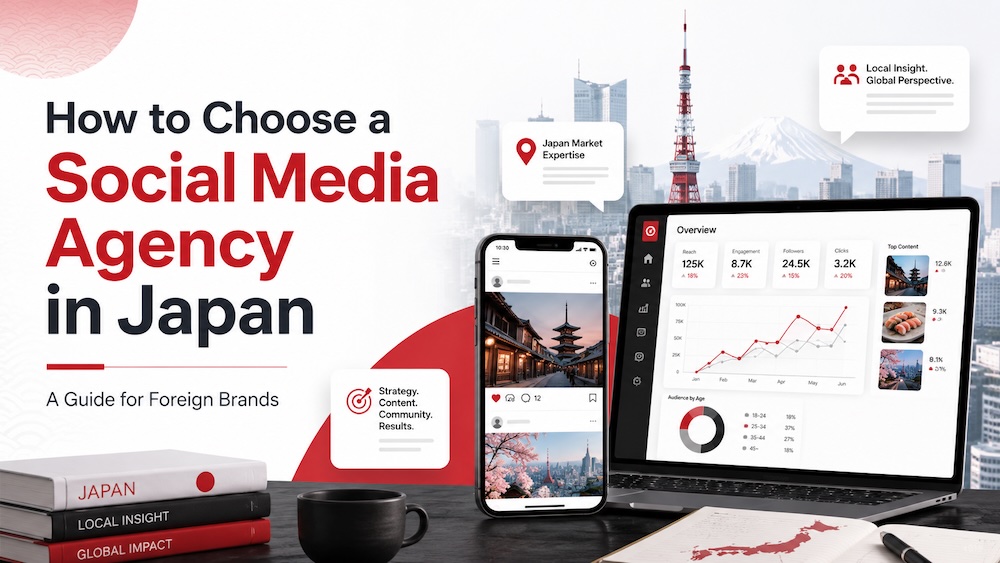
Hiring a social media agency in Japan is not the same as hiring a general translation vendor or asking your global marketing team to post in Japanese.
Japan is a mature, highly active, and culturally specific social media market. According to コムニコ「We Love Social」 2026年5月版 SNSユーザー数ランキング, LINE alone surpassed 100 million domestic monthly active users at the end of December 2025, and X, Instagram, YouTube and TikTok each reach tens of millions of users in Japan. Dentsu also reported that internet advertising accounted for 50.2% of Japan’s total advertising expenditures in 2025, exceeding half of the market for the first time.[1]
In other words, social media is no longer a side channel in Japan. It is one of the main places where people discover, evaluate, trust, ignore, or reject brands.
For foreign companies, the question is not simply, “Which platform should we use in Japan?” The more important question is:
Who can operate our brand in Japanese in a way that feels local, protects our global positioning, and produces business results?
This guide explains what foreign brands should look for when choosing a social media agency in Japan, what mistakes to avoid, and how to evaluate whether a partner is truly capable of managing Japanese SNS strategy and execution.
Why Foreign Brands Need a Different Social Media Approach in Japan
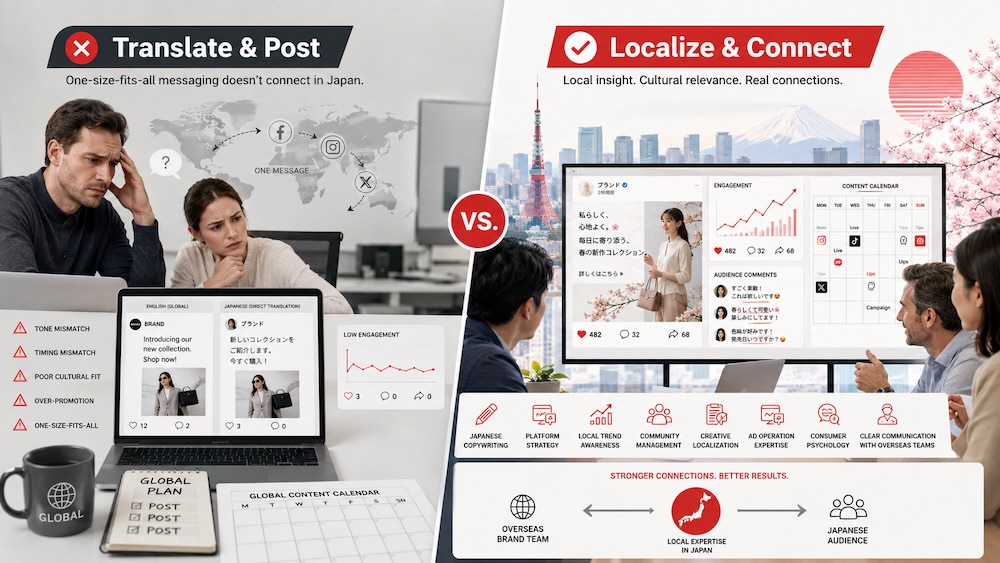
Many international companies enter Japan with a simple assumption: translate the global posts, adjust the hashtags, publish regularly, and results will follow.
That usually does not work.
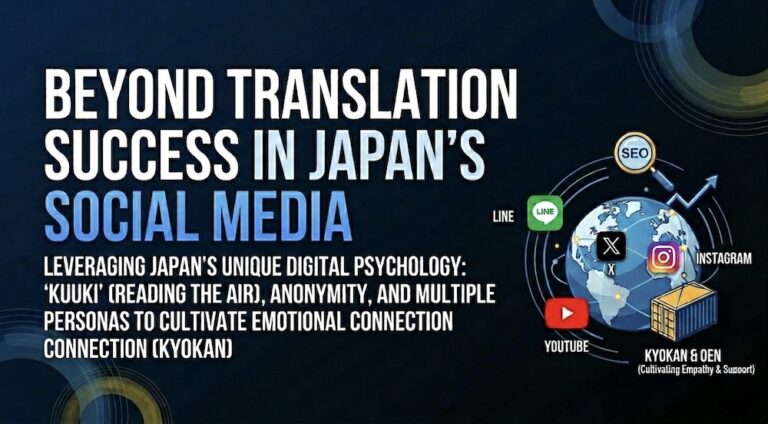
Japanese social media users are sensitive to tone, timing, context, and subtle cultural signals. A post can be grammatically correct but still feel awkward. A campaign can be visually polished but still fail because the message feels too direct, too promotional, or disconnected from how Japanese consumers actually talk. We unpack the structural reasons behind this in detail in why most foreign social media strategies fail in Japan.
This is why social media management in Japan requires more than language ability. It requires:
- Japanese copywriting
- platform-specific planning
- local trend awareness
- community management
- creative localization
- ad operation knowledge
- an understanding of Japanese consumer psychology
- the ability to communicate clearly with overseas teams
A weak local partner may simply “translate and post.” A strong partner rebuilds the message so that it can actually work in Japan. If you want to see what “translate and post” actually looks like when it goes wrong, our breakdown of the most common ways foreign brands crash and burn on Japanese social media shows the failure patterns repeatedly.
Japan’s Social Media Market in 2026: Why Local Execution Matters
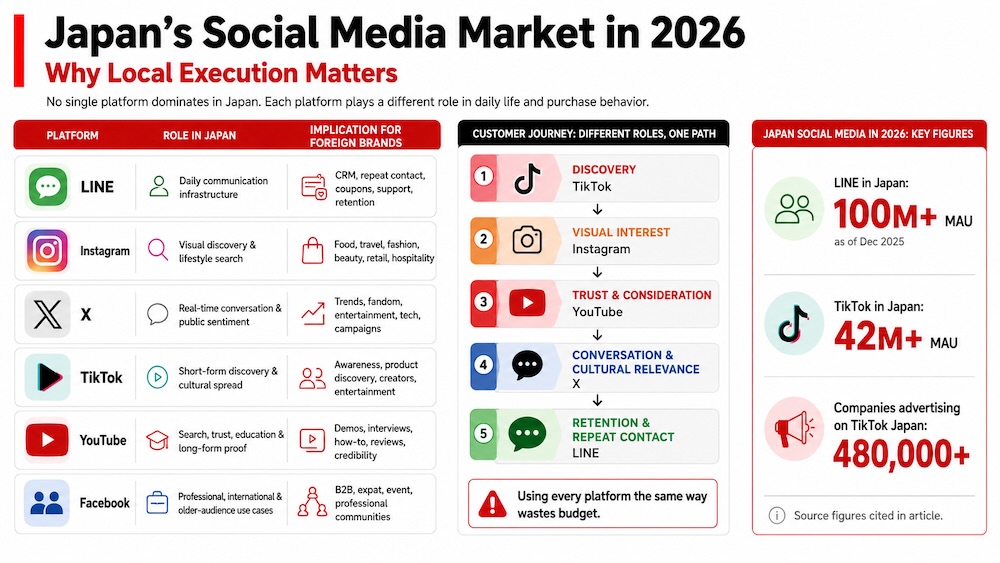
Japan’s social media environment is not dominated by one platform. Each platform plays a different role in daily life and purchase behavior.
| Platform | Role in Japan | Implication for Foreign Brands |
|---|---|---|
| LINE | Daily communication infrastructure | Useful for CRM, repeat contact, coupons, customer support, and retention |
| Visual discovery and lifestyle search | Strong for food, travel, fashion, beauty, retail, lifestyle, and hospitality | |
| X | Real-time conversation and public sentiment | Important for trends, fandom, entertainment, tech, campaigns, and community interaction |
| TikTok | Short-form discovery and cultural spread | Powerful for awareness, product discovery, creators, entertainment, and impulse-driven interest |
| YouTube | Search, trust, education, and long-form proof | Useful for product demos, interviews, how-to content, reviews, and brand credibility |
| Professional, international, and older-audience use cases | Still relevant for some B2B, expat, event, and professional communities |
LINE Yahoo announced that LINE surpassed 100 million monthly active users in Japan as of the end of December 2025.[2] TikTok also announced that its monthly active users in Japan exceeded 42 million, and that more than 480,000 companies were advertising on TikTok in Japan.[3]
Independent benchmarking by コムニコ「We Love Social」 (株式会社コムニコ) confirms the broader picture as of May 2026: LINE 100 million domestic monthly active users, YouTube 73.7 million, X 68 million, Instagram 66 million, TikTok 42 million, and Facebook 26 million.[5]
These numbers matter, but platform size alone should not decide your strategy. A good Japanese social media agency should help you decide what each platform is supposed to do in your customer journey. For a more complete picture of how each platform is actually used by Japanese consumers, see our overview of social media usage in Japan across LINE, X, Instagram, TikTok, and YouTube.
For example, TikTok may create first discovery. Instagram may deepen visual interest. YouTube may build trust. LINE may drive repeat communication. X may create conversation and cultural relevance.
Using every platform the same way is one of the fastest ways to waste budget in Japan.
What a Social Media Agency in Japan Should Actually Do
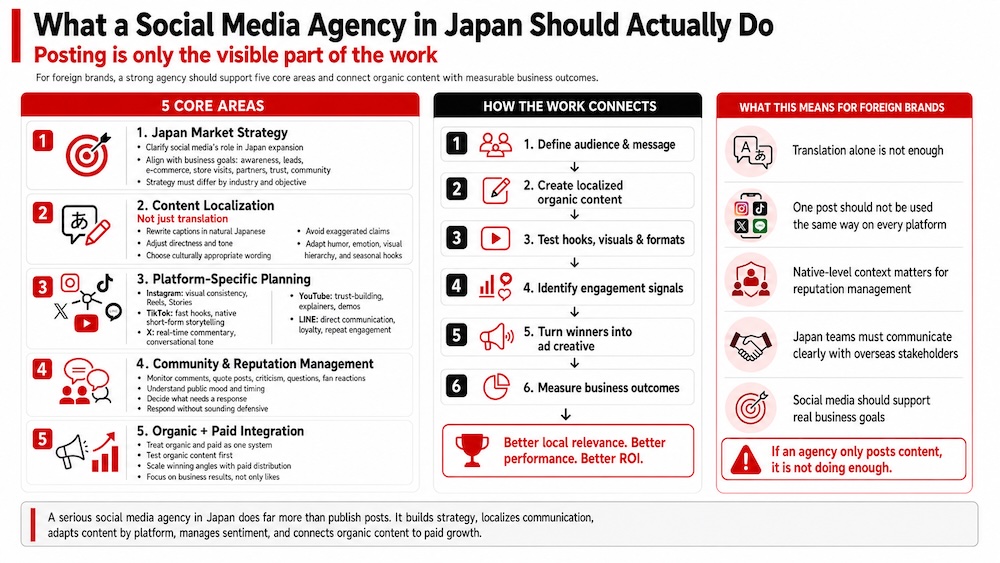
A serious social media agency in Japan should not only post content. Posting is just the visible part of the work.
For foreign brands, the agency should help with five core areas.
1. Japan Market Social Media Strategy
Before creating content, the agency should clarify the role of social media in your Japan expansion.
Are you trying to build awareness before launch? Generate leads? Support e-commerce? Drive store visits? Recruit partners? Build trust before sales meetings? Grow a local fan community?
The right strategy depends on the business objective. A B2B SaaS company, a tourism brand, a beauty product, a restaurant group, and a consumer electronics company should not use the same social media strategy in Japan.
2. Content Localization, Not Just Translation
Translation changes the language. Localization changes the message so it fits the market.
This includes:
- rewriting captions in natural Japanese
- adjusting the level of directness
- choosing culturally appropriate words
- avoiding claims that feel too exaggerated
- adapting humor and emotional tone
- changing visual hierarchy for Japanese users
- using local seasonal hooks
For example, an English caption that sounds confident may feel pushy in Japanese. A short global campaign slogan may need additional context to feel trustworthy. A visual that works in the US or Europe may not explain enough for Japanese users.
This is why a Japan social media partner must understand both global branding and Japanese communication norms.
3. Platform-Specific Content Planning
A strong agency should not create one post and push it everywhere.
Instagram, TikTok, X, YouTube, and LINE each require different formats, pacing, and user expectations. If your team needs a fast operational reference, our 2026 quick guide to navigating social media in Japan summarizes how each platform behaves and what content actually works.
- Instagram: visual consistency, Reels, Stories, highlights, lifestyle context, product appeal
- TikTok: fast hooks, native short-form storytelling, creator logic, discovery-first structure
- X: real-time commentary, cultural timing, conversational tone, community awareness — we explain why X marketing works differently in Japan and how small accounts can still reach massive audiences here.
- YouTube: trust-building, explainers, interviews, product demonstrations, longer-form proof
- LINE: direct communication, campaign distribution, loyalty, reservations, repeat engagement
If an agency cannot explain how content should change by platform, it is probably not ready to operate your brand seriously in Japan.
4. Community Management and Reputation Awareness
Social media in Japan is not only about publishing. It is also about reading the room.
Brands need to understand comments, quote posts, indirect criticism, customer questions, fan reactions, and current public mood. This is especially important on X, where Japanese users often discuss brands in real time.
A local agency should help you identify:
- what users are saying about your category
- which comments need a response
- which comments should not be amplified
- when a post may be poorly timed
- whether criticism is serious or temporary noise
- how to respond without sounding defensive
This is one of the biggest reasons foreign brands need local support. It is very difficult to manage Japanese online sentiment from overseas without native-level context.
5. Paid Social and Organic Content Working Together
Organic social media and paid social ads should not be treated as separate worlds.
Dentsu’s detailed analysis of Japan’s internet advertising market reported that video advertising exceeded 1 trillion yen in 2025 for the first time, with strong growth in SNS-based vertical video ads.[4]
This means more brands are competing for attention through short-form video, social ads, and platform-native creative. A Japan social media agency should understand how to test organic content, identify winning angles, and then use paid distribution to scale what works.
The basic sequence should be:
- define the audience and message
- create localized organic content
- test hooks, visuals, and formats
- identify engagement signals
- turn strong content into ad creative
- measure business outcomes, not only likes
For a deeper example of why impressions alone are not enough, see our case study on two viral X campaigns in Japan: viral X campaigns in Japan do not always drive sales. The comparison of McDonald’s Japan and Nissin Donbei shows why a Japan social media agency must connect creative attention to purchase behavior — not just buzz.
Common Mistakes When Hiring a Social Media Agency in Japan
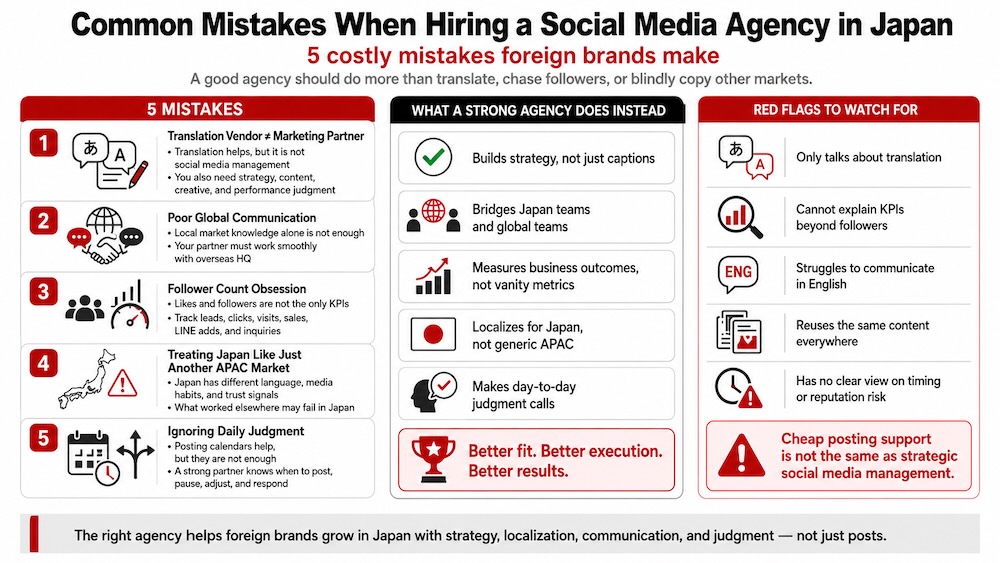
Mistake 1: Hiring a Translation Vendor Instead of a Marketing Partner
If your partner only translates captions, they are not managing social media. They are supplying language support.
That may be useful, but it is not enough for growth.
Social media management requires content planning, audience understanding, creative direction, performance review, and business judgment. Translation is only one part of the process.
Mistake 2: Choosing an Agency That Cannot Communicate With Your Global Team
Many Japanese agencies understand the domestic market but struggle to communicate smoothly with overseas headquarters. On the other hand, many global agencies understand English but do not have deep Japanese execution capability.
Foreign brands need both.
The ideal partner can explain Japanese user behavior in English, understand your global brand guidelines, and still create content that feels natural in Japan.
Mistake 3: Focusing Only on Follower Growth
Follower count is easy to understand, but it is not always the best KPI.
Depending on your business, better KPIs may include:
- qualified inquiries
- website visits
- profile visits
- store visits
- reservation clicks
- LINE friend additions
- e-commerce sales
- brand search growth
- creator content performance
- lead generation
A good agency should challenge weak KPIs. If your goal is sales, they should not report only likes.
Mistake 4: Expecting Japan to Respond Like Another Asian Market
Japan should not be treated as simply “one APAC country.” The language, media habits, platform mix, customer expectations, and trust-building process are different.
A campaign that worked in Singapore, Korea, Thailand, or Taiwan may not automatically work in Japan.
Local adaptation is not optional. It is the work.
Mistake 5: Underestimating the Need for Daily Judgment
Social media requires ongoing judgment. A monthly content calendar is useful, but it cannot predict every trend, news event, comment, or market reaction.
Your Japan partner should be able to advise when to post, when to pause, when to adjust, and when to respond.
That kind of judgment is hard to outsource cheaply.
Checklist: How to Evaluate a Japanese Social Media Agency
Before hiring a social media agency in Japan, ask these questions.
Strategy
- Can they explain how Japanese users behave differently by platform?
- Can they connect social media activity to your business objective?
- Can they recommend what not to do?
- Can they create a practical launch plan for the first 90 days?
Localization
- Can they rewrite content, not just translate it?
- Can they explain why a phrase may feel unnatural in Japanese?
- Can they adapt tone for different industries and audiences?
- Can they handle Japanese copywriting, captions, replies, and campaign language?
Execution
- Can they manage Instagram, X, TikTok, YouTube, and LINE based on each platform’s role?
- Can they produce or direct short-form video?
- Can they manage posting operations consistently?
- Can they analyze performance and improve content over time?
Communication
- Can they communicate with your overseas team in English?
- Can they explain Japanese market feedback clearly?
- Can they manage approval flows across time zones?
- Can they protect your global brand while localizing for Japan?
Growth
- Can they combine organic content with paid social ads?
- Can they support influencer or creator collaborations?
- Can they connect social media with SEO, landing pages, and lead generation?
- Can they report on outcomes that matter to your business?
What Should the First 90 Days Look Like?
A realistic first 90-day social media plan in Japan should not begin with random posting. It should begin with diagnosis and positioning.
Days 1–30: Research and Strategy
- review your global brand assets
- analyze competitors in Japan
- define target audiences
- select priority platforms
- adapt key messages into Japanese
- design content pillars
- set KPIs and reporting structure
Days 31–60: Content Testing
- publish initial localized content
- test different hooks and formats
- compare platform response
- collect comments and qualitative feedback
- adjust tone, visuals, and posting rhythm
- identify early winning themes
Days 61–90: Optimization and Growth
- increase output around stronger themes
- start paid amplification if content signals are positive
- test creator or influencer collaboration
- connect social media with landing pages or inquiry forms
- review KPIs against business goals
- decide what to scale next
The first 90 days should create clarity: which platforms matter, which messages resonate, which creative angles work, and what kind of investment is justified.
How Much Social Media Support Do Foreign Brands Need in Japan?
Not every company needs the same level of support.
Some brands only need a local strategy and content review. Others need full account management, Japanese copywriting, posting, reporting, influencer coordination, and paid social advertising.
In general, foreign brands should choose one of three models.
Model 1: Advisory Support
Best for companies with an internal team but limited Japan knowledge.
- market and platform advice
- Japanese copy review
- content calendar feedback
- campaign localization guidance
Model 2: Hybrid Operation
Best for companies that can create global assets but need Japan-side execution.
- localized content planning
- Japanese captions and adaptation
- posting support
- community monitoring
- monthly performance review
Model 3: Full Social Media Management
Best for brands entering Japan without a local marketing team.
- strategy
- content planning
- creative direction
- Japanese copywriting
- posting operation
- community management
- paid social ads
- influencer and creator coordination
- reporting and optimization
The right model depends on your internal resources, speed of entry, budget, and growth goals.
Why Work With JDOC for Social Media Management in Japan?
JDOC is a Tokyo-based digital marketing company helping global brands grow in Japan.
We support social media strategy, content localization, posting operations, advertising, influencer collaboration, and Japan market entry communication. Our role is to bridge the gap between your global brand vision and what Japanese users actually respond to.
We do not simply translate words. We reconstruct your message for the Japanese market.
Our support can include:
- Japan social media strategy
- Instagram, X, TikTok, YouTube, and LINE planning
- Japanese content localization
- copywriting and creative direction
- short-form video planning
- social media advertising
- influencer and creator casting
- monthly reporting and performance improvement
- Japan market entry consultation
If your brand is entering Japan and needs a local social media partner who can communicate in English while executing in Japanese, JDOC can help.
Contact JDOC to discuss social media management, localization, and growth strategy for Japan.
Book a free consultation with JDOC
FAQ: Hiring a Social Media Agency in Japan
Do foreign brands need a Japanese social media agency?
If your brand wants to reach Japanese users, a local partner is usually necessary. Japanese social media requires local language, cultural context, platform knowledge, and day-to-day judgment. A global team can provide brand direction, but Japan-side execution should be localized.
Is translation enough for Japanese social media?
No. Translation is not enough. Japanese social media content should be localized for tone, context, platform behavior, seasonality, and user expectations. Direct translation often sounds unnatural or too promotional.
Which social media platform is best in Japan?
There is no single best platform. LINE, Instagram, X, TikTok, YouTube, and Facebook each serve different purposes. The right choice depends on your industry, audience, and business objective.
Can social media generate leads in Japan?
Yes, but only when social media is connected to a clear customer journey. For B2B brands, social media may build trust and drive inquiries. For consumer brands, it may support discovery, EC sales, store visits, or LINE registration.
Should foreign brands use influencers in Japan?
Influencers can be effective, but only when they fit the brand, audience, platform, and campaign goal. In Japan, micro-creators and niche communities can sometimes be more valuable than large accounts with broad reach.
How long does it take to see results?
Early signals can appear within the first 30 to 90 days, but meaningful growth usually requires continuous testing and improvement. Japan is a trust-sensitive market, so brands should not expect instant results from generic content.
Sources
- Comnico Inc., “We Love Social — Social Media User Numbers in Japan and Globally: Ranking of 15 Major Platforms Including X, Instagram and TikTok (May 2026 Edition)” (May 1, 2026): comnico.jp/we-love-social/sns-users
- Institute for Information and Communications Policy, Ministry of Internal Affairs and Communications (MIC), “Survey on Time Spent on Information and Communication Media and Information Behavior, Fiscal Year 2024 — Report” (Japanese Government, June 27, 2025): soumu.go.jp/main_content/001017160.pdf