— A Practical Platform-by-Platform Playbook for the Japanese Market —
Japan is one of the most active digital markets in the world, but social media in Japan does not behave exactly like social media in the United States, Europe, or Southeast Asia.
That is where many foreign businesses make their first mistake.
They look at Japan, see high internet penetration, large social media audiences, and familiar platform names such as Instagram, TikTok, YouTube, and X. Then they assume the same global playbook will work. It usually does not — and we have explained in detail why social media strategy in Japan fails for foreign brands.
Japan had 107 million internet users at the end of 2025, and DataReportal estimated 99.0 million social media user identities in Japan in October 2025, equivalent to 80.5% of the population. However, DataReportal also notes that “user identities” do not always represent unique individuals, so these numbers should be treated as directional rather than perfectly clean headcounts.
For foreign companies, the real question is not simply:
“Which social media platform is biggest in Japan?”
The better question is:
“Which platform should we use for awareness, trust, conversion, customer retention, and long-term brand building in Japan?”
Those are very different questions.
At JDOC, we often see overseas brands arrive in Japan with a strong preference for Instagram. That is understandable. Instagram is visual, global, easy for headquarters to understand, and useful for lifestyle branding. But in Japan, Instagram is not always the whole answer. X can still create explosive visibility. LINE is often more important for customer retention than brand discovery. YouTube is crucial for trust. TikTok and TikTok Shop can create short-term sales spikes, but turning that attention into repeatable revenue is harder than it looks.
This guide explains how social media is actually used in Japan, how each platform fits into a marketing strategy, and what foreign businesses should be careful about before investing heavily in Japanese SNS marketing.
The Current Social Media Landscape in Japan
Japan’s social media market is large, mature, and highly platform-specific.
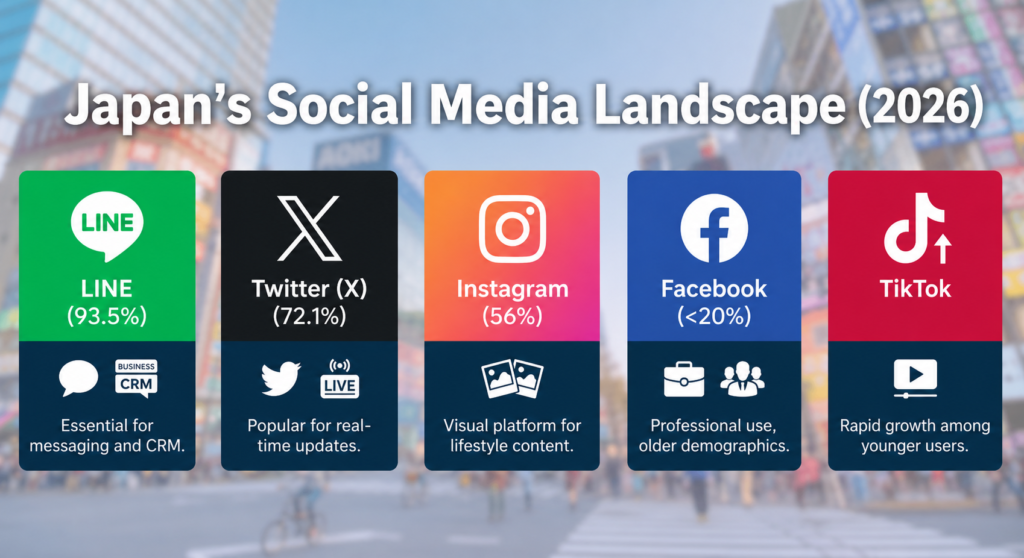
According to Comnico’s May 2026 ranking of major social media platforms in Japan, the largest domestic platforms by published user figures are LINE, YouTube, X, Instagram, TikTok, and Facebook. Comnico also notes that the figures are based on official platform announcements and that the timing of each platform’s published data differs.
| Platform | Published domestic user figure | Best understood as |
|---|---|---|
| LINE | 100 million+ | Daily communication infrastructure and CRM |
| YouTube | 73.7 million+ | Search, entertainment, education, and trust-building |
| X | 68 million+ | Real-time conversation, trends, fandom, and viral spread |
| 66 million+ | Visual discovery, lifestyle branding, and social proof | |
| TikTok | 42 million+ | Short-form discovery, entertainment, and viral product exposure |
| 26 million+ | Older users, expats, business communities, and niche B2B use |
LINE also officially announced that it surpassed 100 million monthly active users in Japan, making it less like a normal social network and more like a daily communication layer in Japanese life.
But user numbers alone do not tell you how to use each platform. A platform can be large and still be wrong for your immediate business goal. Instagram may be strong for visual branding but weak for direct explanation. TikTok may generate attention but not necessarily repeat purchases. LINE may not create much organic discovery, but it can be extremely useful once someone has already shown interest. X may look chaotic from the outside, but in Japan it still has a level of real-time cultural influence that many foreign companies underestimate.
That is why platform selection in Japan should start with business purpose, not platform popularity. For a faster overview, see our quick guide to navigating social media in Japan (2026 edition).
Why Japan Is Different from Western Social Media Markets
Foreign businesses often underestimate three things about Japan.
| Key difference | What it means for foreign brands |
|---|---|
| 1. Cautious consumers | Japanese users look for Japanese-language communication, local reviews, clear customer support, familiar payment methods, and consistency before they trust a new brand. |
| 2. Different platform behavior | The same app plays a different role here. LINE is daily infrastructure, not just chat. X still drives real-time culture, fandom, and news. Instagram is important but not dominant. |
| 3. Separated public and private identities | One user can behave like five different people: Instagram for lifestyle, X for anonymous commentary, LINE for real relationships, YouTube for research, TikTok for entertainment. |
This is why a simple “post the same content everywhere” approach usually produces weak results.
The Most Common Mistake: Starting with Instagram Because It Feels Familiar
Many foreign brands want to start with Instagram in Japan. That is not wrong by itself. Instagram is widely used in Japan, especially for food, fashion, beauty, travel, lifestyle, design, and premium consumer products. Meta’s advertising tools also show Instagram has large reach in Japan, with DataReportal reporting 63.2 million users in late 2025 based on Meta’s ad tools.
The problem is not Instagram. The problem is assuming Instagram can do everything.
Instagram is good when your product is visually attractive, your brand world is clear, and you can produce content consistently. It is also useful when users want to check whether your brand “feels real” in Japan. A weak or inactive Instagram account can damage trust, especially for restaurants, hotels, shops, beauty brands, and consumer goods.
But Instagram is often weaker when the product needs explanation, when the purchase decision is rational, when users need to compare details, or when the brand is still unknown and has no local proof.
In Japan, many overseas brands over-invest in Instagram before answering more basic questions:
- Do Japanese users understand what we sell?
- Is the value proposition localized, or just translated?
- Do we have Japanese reviews, case studies, or proof?
- Do we have a landing page that explains the product clearly?
- Do we have a LINE, email, or website flow to capture people after they show interest?
- Are we using X, YouTube, or search content to create credibility outside Instagram?
Instagram can be part of the answer. It should rarely be the entire strategy. If you want to see exactly how this kind of single-platform thinking goes wrong, our breakdown of 5 ways foreign brands crash and burn on Japanese social media covers the most common failure patterns.
LINE: The Platform Foreign Brands Often Underestimate
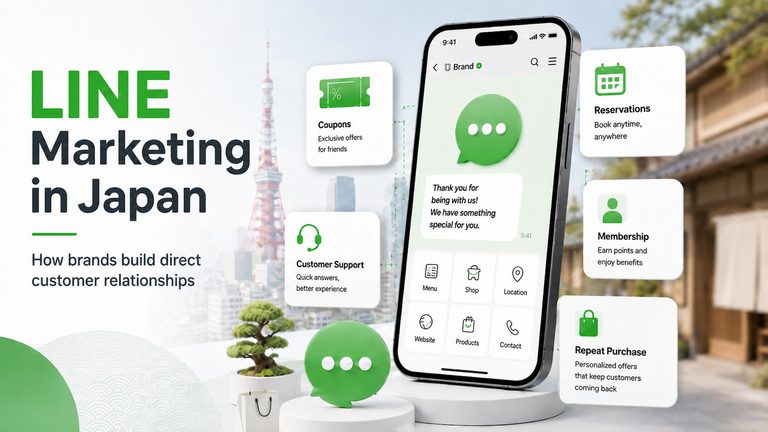
LINE is the most important platform in Japan that many foreign businesses do not fully understand. In many countries, messaging apps and social media marketing are treated separately. In Japan, LINE sits between communication, CRM, customer support, promotions, and retention.
For new customer discovery, LINE is usually not the first touchpoint. People do not randomly discover a foreign brand on LINE in the same way they might on TikTok, Instagram, X, or YouTube. But once someone knows your brand, LINE can be powerful.
Restaurants use it for coupons and reservations. Clinics use it for reminders. Schools use it for updates. Retailers use it for campaigns and repeat purchase. Local businesses use it to stay close to customers without relying entirely on social algorithms.
Good use cases for LINE
- Restaurants and cafes
- Beauty salons and clinics
- Gyms and wellness businesses
- Tourism operators
- Schools and education services
- Retail stores
- D2C brands with repeat purchase potential
- Local service businesses
The key is to treat LINE as a relationship channel, not a broadcasting tool. If all you do is send generic promotions, users will mute or block the account. LINE works best when the messages are useful: reminders, limited offers, booking links, membership benefits, post-purchase support, or localized customer care.
The right sequence for most foreign brands
| Step | Goal | Typical channels |
|---|---|---|
| 1. Awareness | Reach new audiences in Japan | Instagram, TikTok, X, YouTube, ads, PR, search |
| 2. Trust | Make Japanese users believe in the brand | Website content, reviews, case studies, YouTube |
| 3. Capture | Turn interested users into known leads | LINE, email, booking flows, owned channels |
| 4. Retention | Bring customers back and increase LTV | LINE, email, loyalty programs, member benefits |
LINE is not always the loudest platform. But in Japan, it is often one of the most commercially useful.
X: Do Not Underestimate Its Explosive Power in Japan
X is one of the most misunderstood platforms in Japan. Outside Japan, some marketers think of X as unstable, political, declining, or too chaotic for brand marketing. In Japan, that view is too simplistic.
X still has serious cultural force. Comnico’s May 2026 data lists X at 68 million+ domestic monthly active users, and notes that Japan is one of X’s most important markets. Comnico also describes X as highly real-time and highly shareable, while warning that these same strengths can create reputational risk.
That is exactly the point. X is risky because it spreads quickly. But it is valuable for the same reason. We go deeper into this dynamic in why X marketing works differently in Japan, including how an account with only 100 followers can still reach a million people through Japan’s repost culture.
Where X is especially strong in Japan
- Anime, manga, games, and entertainment
- Food and limited-time campaigns
- Memes and cultural moments
- Live events
- Fan communities
- Product launches
- Brand reactions and public conversation around ads and commercials
- Niche enthusiast groups
For foreign brands, X can create visibility that Instagram alone may not produce. A strong post, clever campaign, creator mention, or user-driven conversation can travel very fast. Small accounts can sometimes reach far beyond their follower base because repost culture is still active.
But X is not a place for careless posting. Japanese users are sensitive to tone, wording, hidden advertising, poor localization, and brands that appear to misunderstand Japanese context. A phrase that sounds harmless in English may feel awkward, arrogant, insensitive, or simply “off” in Japanese.
A good X strategy in Japan should include native Japanese copywriting, fast (but not forced) response to trends, clear campaign rules, social listening, careful risk checks before posting, a defined response policy for criticism, and content that gives people a reason to repost.
Crucially, viral attention does not automatically equal sales. Our case study on McDonald’s Japan vs. Nissin Donbei shows two viral X campaigns side by side and explains why one converted into purchase behavior and the other did not.
YouTube: The Trust-Building Platform
YouTube is often overlooked because it requires more production effort than short-form social media. That is a mistake.
YouTube is not only entertainment. In Japan, it is also a search engine, a review platform, an education platform, and a trust-building platform. Comnico’s May 2026 ranking lists YouTube at 73.7 million+ domestic users, making it one of the largest platforms in the country.
For foreign businesses, YouTube is especially useful when the product or service needs explanation. That includes B2B services, SaaS, education, tourism experiences, high-ticket consumer products, beauty and wellness services, real estate, finance-related services, technical products, and cultural products.
A Japanese user may not convert after seeing one Instagram post. But they may watch a video that explains how the product works, who is behind the company, what the experience looks like, or how other customers use it.
YouTube also works well as supporting proof. Even when YouTube is not the first touchpoint, videos can be embedded in landing pages, used in ads, shared by sales teams, and repurposed into Shorts, Instagram Reels, TikTok clips, and website content.
For foreign companies, the best YouTube strategy is usually not to create polished corporate videos only. It is better to create content that answers real questions:
- What is this product?
- Why is it useful in Japan?
- How does it compare with local alternatives?
- Who is using it?
- What does the experience actually look like?
- Can I trust this company?
Short-form video creates attention. YouTube can help turn that attention into understanding.
Instagram: Important, But Not a Complete Japan Strategy
Instagram matters in Japan. It is highly relevant for visual categories such as fashion, beauty, food, travel, hotels, interior design, art, culture, luxury products, and lifestyle brands. It is also important because users often check Instagram to confirm whether a business looks active, attractive, and trustworthy.
For restaurants, retail stores, hotels, and experience-based businesses, Instagram can act as a visual storefront. Before visiting, users want to see atmosphere, menu, service style, room quality, product packaging, or customer experience.
But Instagram has limitations. It is not always the best place for deep explanation, viral public conversation, or customer retention. And depending on the category, it may not be the best first investment if the business has no Japanese-language foundation yet.
Use Instagram in Japan only if you can commit to:
- Strong visual direction
- Consistent posting
- Japanese captions that feel natural
- Localized creative, not just global assets
- Creator collaboration
- Stories and Reels
- Clear profile design
- A landing page or shop flow after interest is created
The biggest mistake is treating Instagram as a safe default. It is safe only when it fits the business goal. For many brands, Instagram should be combined with X for spread, YouTube for trust, LINE for retention, and search content for explanation.
TikTok and TikTok Shop: Great for Spikes, Harder for Sustainable Sales
TikTok is now impossible to ignore. It has changed how products are discovered, especially among younger users. It is strong for short-form entertainment, creator-led discovery, beauty, food, gadgets, lifestyle products, tourism, and anything that can be demonstrated quickly.
TikTok Shop also launched in Japan on June 30, 2025, allowing users to discover and purchase products inside the app through shopping videos, LIVE commerce, product showcases, shop tabs, affiliate programs, and TikTok Shop ads.
Japan is no exception to the global shift toward discovery commerce. A product can suddenly gain attention through a creator, a trend, a product demonstration, or a short video that makes people want to try it immediately. But this is where foreign businesses need to be careful.
| TikTok / TikTok Shop is good for… | TikTok / TikTok Shop is harder for… |
|---|---|
| Short-term sales spikes | Sustainable, repeatable revenue |
| Products that “pop” quickly | High-consideration, complex purchases |
| Impulse purchases | Trust-heavy categories (health, finance, B2B) |
| Making a product feel culturally current | Building a defensible long-term brand alone |
| Affordable, visually demonstrable items | Expensive items needing detailed comparison |
To keep selling after the first wave, a brand needs repeatable creative production, creator management, inventory control, customer support, review management, pricing strategy, logistics, advertising optimization, product-market fit, landing pages or owned channels outside TikTok, and a plan for repeat purchase.
A temporary buzz does not automatically become a business. TikTok Shop should be treated as a powerful sales and discovery channel, but not a substitute for brand strategy. It is strongest when it sits inside a broader system: TikTok for discovery, creator content for trust, TikTok Shop for impulse purchase, LINE or email for retention, and website/search content for long-term credibility.
Facebook and LinkedIn: Smaller, But Not Useless
Facebook is no longer the dominant social platform for broad consumer marketing in Japan. However, it is not dead. It can still matter for older demographics, expat communities, local business communities, international professionals, events, and certain B2B contexts. Comnico’s May 2026 ranking lists Facebook at 26 million+ domestic users, although the source date for that figure is older than some other platform figures.
LinkedIn is more limited in Japan than in many Western markets, but it can still be useful for B2B, recruiting, executive branding, and international business development. DataReportal reported LinkedIn ad reach in Japan at 5.1% of the population aged 18 and above in late 2025.
For foreign B2B companies, LinkedIn may be useful when targeting internationally minded professionals, Japanese employees at global companies, overseas headquarters, or Japan market entry partners. But if the target is domestic Japanese SMEs, LinkedIn alone will usually be too narrow. For B2B in Japan, the stronger mix is often website content for search and credibility, case studies, seminars or webinars, email, X for thought leadership and visibility, LinkedIn for international and executive-facing communication, and direct sales or partner outreach.
Choosing the Right Platform by Business Objective
The easiest way to choose a platform in Japan is to start with the business objective.
| Business objective | Strong platforms | Why |
|---|---|---|
| Mass awareness | TikTok, X, Instagram, YouTube Shorts | Short-form and shareable content can reach new audiences |
| Cultural buzz | X, TikTok | Strong spread through trends, reposts, creators, and communities |
| Visual brand building | Instagram, TikTok, YouTube | Good for lifestyle, food, travel, beauty, fashion, and design |
| Trust and explanation | YouTube, website content, case studies | Better for products that need depth |
| Customer retention | LINE, email, owned communities | Strong for repeat purchase, reservations, and reminders |
| B2B lead generation | Website, LinkedIn, X, webinars, email | Requires credibility and clear explanation |
| Store visits | Instagram, Google Maps, TikTok, LINE | Users need visuals, reviews, access, and reminders |
| Product launch | X, TikTok, Instagram, PR, creators | Needs concentrated visibility |
| Long-term brand building | YouTube, Instagram, website, LINE | Requires repeated trust signals |
This is the point foreign businesses should understand: Japan social media strategy is not about choosing one winner. It is about assigning the right job to the right platform.
Recommended Platform Mix by Industry
| Industry | Discovery | Trust & Explanation | Retention | Notes |
|---|---|---|---|---|
| D2C / Consumer Products | TikTok, Instagram, X | YouTube, reviews | LINE, email | Avoid relying only on ads or one-off influencer posts. |
| Food & Beverage | Instagram, X, TikTok | Google Maps, reviews | LINE coupons & reservations | Physical locations also need strong Google Maps presence. |
| Travel & Tourism | Instagram, TikTok | YouTube, website | LINE during/after trip | Reduce anxiety, not just show scenery. |
| Beauty / Wellness / Clinics | Instagram, TikTok | YouTube, Google reviews | LINE booking flows | Be careful with advertising claims (legal risk). |
| SaaS / B2B | X, LinkedIn, ads | JP website, case studies, webinars | Email nurturing, sales follow-up | Do not copy a consumer SNS strategy. |
| Luxury & Premium | Instagram, YouTube, PR | YouTube, editorial coverage | CRM, private channels | Subtlety matters; aggressive selling cheapens the brand. |
D2C and Consumer Products
For D2C brands, TikTok, Instagram, X, YouTube Shorts, and LINE can all play a role. TikTok and TikTok Shop are useful for discovery and short-term sales. Instagram is useful for brand image and social proof. X can support campaigns and conversation. LINE can support repeat purchase. YouTube can provide product education when the item needs demonstration. The mistake is relying only on performance ads or only on influencer posts. Japanese consumers often need repeated proof before buying from a new foreign brand.
Food and Beverage
For restaurants, cafes, and food brands, Instagram remains important. But X and TikTok can be just as important depending on the concept. X can create buzz around limited-time menus, collaborations, seasonal items, and humorous brand communication. TikTok can show the experience quickly. Instagram helps users check atmosphere. LINE can bring people back through coupons, reservation reminders, and member benefits.
For physical locations, Google Maps also matters heavily. Social media may create desire, but many users will still check reviews, location, photos, opening hours, and route information before visiting.
Travel and Tourism
For travel brands, Instagram and TikTok are strong for inspiration. YouTube is strong for deeper planning. X can work for real-time travel conversation, events, transport updates, and niche fan communities. LINE can support guests after booking or during the trip.
Foreign tourism companies should not only show beautiful scenery. They should reduce anxiety: where to meet, what is included, how much Japanese is needed, what happens if it rains, whether solo travelers are welcome, and what kind of experience guests can expect.
Beauty, Wellness, and Clinics
Instagram and TikTok are strong for discovery, but trust is critical. Before booking, Japanese users often want to see reviews, before-after context, staff credibility, price transparency, safety information, and clear explanations. YouTube, website content, Google reviews, and LINE booking flows can all support conversion. This category also requires extra care with advertising claims. Overpromising results can create legal and reputational risk.
SaaS and B2B
For SaaS and B2B, do not copy a consumer SNS strategy. Instagram may help employer branding or brand atmosphere, but it is rarely the main engine of serious B2B lead generation in Japan. For B2B, the foundation should be clear Japanese-language website content, use cases, case studies, webinars, downloadable resources, email nurturing, and sales follow-up. X and LinkedIn can support thought leadership, but the content must be specific. Generic “digital transformation” posts will disappear. Practical insights, market commentary, and real examples work better.
Luxury and Premium Brands
Luxury brands need consistency more than volume. Instagram, YouTube, high-quality website content, PR, creators, and carefully selected offline experiences are usually more important than chasing every trend. X and TikTok can work, but only if the brand knows how to adapt without damaging its positioning. In Japan, subtlety often matters. Too much aggressive selling can cheapen the brand.
Localization Is Not Translation
Foreign brands often say they have localized their social media when they have only translated the captions. That is not localization.
Localization means adjusting the message, tone, visual rhythm, offer, proof, and customer journey to fit the Japanese market. A translated English campaign often feels too direct in Japanese. It may sound overly confident, too casual, too vague, or strangely emotional. Japanese users may not immediately understand what the product is, why they should trust it, or how it fits into their lives.
| Good localization asks… |
|---|
| Does the Japanese copy sound natural? |
| Is the value proposition clear in Japan? |
| Are we using proof that Japanese users care about? |
| Are the visuals aligned with local taste? |
| Is the CTA too aggressive? |
| Are we explaining enough? |
| Are we hiding too much behind brand language? |
| Are we respecting seasonal timing, social context, and cultural nuance? |
Japan rewards brands that are clear, consistent, and respectful. It does not reward brands that simply translate global slogans and hope for the best.
Influencer Marketing and Advertising Disclosure in Japan
Influencer marketing can work well in Japan, but foreign brands need to be careful with disclosure. Since October 1, 2023, stealth marketing has been treated as a violation of Japan’s Act against Unjustifiable Premiums and Misleading Representations. The Consumer Affairs Agency explains that hiding the fact that something is advertising can mislead consumers by making them believe a message is a neutral third-party opinion.
In practice, this means foreign businesses should be careful when working with creators, reviewers, affiliates, ambassadors, or media partners. The basic rule is simple: if content is paid, sponsored, gifted with conditions, or controlled by the brand, the commercial relationship should be clear.
For Japan campaigns, brands should prepare:
- Clear PR disclosure rules
- Creator briefing documents
- Prohibited claims
- Approval flows
- Screenshot records
- Campaign terms
- Internal checks for Japanese wording
- Category-specific legal review when necessary
This is especially important for beauty, health, wellness, supplements, finance, children’s products, and anything involving performance claims. The issue is not only legal risk. Japanese users can react strongly when they feel a brand is hiding something. Trust is hard to build and easy to lose.
A Practical 90-Day Social Media Launch Plan for Japan
Foreign businesses entering Japan should avoid trying to do everything at once. A better approach is to build a 90-day foundation.
| Phase | Focus | Key deliverables |
|---|---|---|
| Days 1–30 | Research & Positioning | Target audience, competitors, pricing, language tone, customer journey, local listening on X / Instagram / TikTok / YouTube / Google Maps / Amazon / Rakuten |
| Days 31–60 | Build the Core Assets | Japanese landing page, localized brand message, platform profiles, visual direction, FAQ, reviews plan, customer support flow, LINE/email capture, content calendar, creator shortlist, risk guidelines |
| Days 61–90 | Test, Measure, Adjust | Small platform tests, measure profile visits / saves / shares / CTR / inquiries / bookings / purchases / LINE registrations / sentiment |
Days 1–30: Research and Positioning
Start with the market, not the platform. During the first month, define the Japanese target audience, competitor set, product positioning, pricing concerns, language tone, and customer journey. Review what Japanese users already say about similar products. Check search results, X conversations, Instagram accounts, TikTok content, YouTube reviews, Google Maps, Amazon, Rakuten, and relevant forums or communities.
The goal is to answer one question: Why would a Japanese customer trust this brand? Without that answer, posting more content will not solve the problem.
Days 31–60: Build the Core Assets
Before scaling social media, prepare the assets that make social media work: Japanese landing page, localized brand message, platform-specific profile setup, visual direction, FAQ, review or testimonial plan, customer support flow, LINE or email capture flow if relevant, basic content calendar, creator shortlist, and risk and response guidelines.
This is where many foreign brands move too slowly or too quickly. If the foundation is weak, the campaign may generate traffic but not trust.
Days 61–90: Test, Measure, and Adjust
Only after the foundation is ready should the brand test content and campaigns. Run small tests across selected platforms. Do not measure everything by likes. Measure the signals that matter: profile visits, saves, shares, comments, click-throughs, landing page engagement, inquiries, bookings, purchases, LINE registrations, repeat visits, creator content performance, and sentiment on X and comments.
The first 90 days should not be judged only by immediate revenue. In Japan, the first phase often reveals whether the brand message is understandable and trustworthy. That learning is valuable.
Common Mistakes Foreign Businesses Make on Japanese Social Media
Below is a summary of the most frequent pitfalls. For a more detailed breakdown with examples, see our companion guide on 5 ways foreign brands crash and burn on Japanese social media.
| # | Mistake | What to do instead |
|---|---|---|
| 1 | Treating Japan as a translation project | Localize tone, timing, visuals, offer, and proof — not just words |
| 2 | Starting with Instagram without a strategy | Match platform to business goal: explanation, trust, retention, or B2B |
| 3 | Ignoring X | Use X for cultural visibility in food, entertainment, fandom, tourism, etc. |
| 4 | Expecting TikTok Shop to create sustainable sales alone | Pair spikes with operations, retention, and owned channels |
| 5 | Posting the same content on every platform | Repurpose — never copy-paste — across X, Instagram, TikTok, LINE, YouTube |
| 6 | Overlooking customer support | Provide responsive Japanese-language support before scaling campaigns |
| 7 | Hiding advertising relationships | Always disclose PR; respect Japan’s stealth marketing rules |
So, Which Platform Should a Foreign Business Choose First?
There is no universal answer. But there is a practical way to think about it.
| If your priority is… | Start with… |
|---|---|
| Visual and easy-to-understand products | Instagram and TikTok (do not ignore X if your category has conversation potential) |
| Products that need explanation | YouTube and website content early |
| Repeat customers, reservations, local relationships | LINE should be part of the system |
| Cultural buzz, fandom, entertainment, campaigns | X deserves serious attention |
| Demonstrable, impulse-friendly products | TikTok Shop is worth testing |
| B2B | Website, case studies, webinars, direct outreach, X, LinkedIn, Japanese sales materials |
The right strategy is not about picking the trendiest platform. It is about building a system. If you would rather have a local partner build that system with you, our guide on how to choose a social media agency in Japan covers what to look for in a partner.
FAQ
What is the most popular social media platform in Japan?
LINE is the largest platform by domestic monthly active users, with LINE officially announcing that it surpassed 100 million monthly active users in Japan. However, LINE should be understood as a communication and CRM platform, not simply a place for organic brand discovery.
Is Instagram popular in Japan?
Yes. Instagram is widely used in Japan and is especially important for visual categories such as food, fashion, beauty, travel, lifestyle, and retail. But foreign businesses should not assume Instagram alone is enough. It is often better as part of a wider strategy that includes X, YouTube, LINE, search content, or TikTok depending on the business goal.
Is X still important in Japan?
Yes. X remains highly influential in Japan, especially for real-time conversation, entertainment, fandom, campaigns, and viral spread. It also carries reputational risk because content can spread quickly. Brands should use X with local copywriting and clear risk management. See why X marketing works differently in Japan for the full picture.
Is TikTok Shop available in Japan?
Yes. TikTok Shop launched in Japan on June 30, 2025, allowing users to discover and buy products inside TikTok through shopping videos, LIVE shopping, product showcases, affiliate programs, and ads.
Should foreign brands use TikTok Shop in Japan?
It depends on the product. TikTok Shop can be strong for impulse-friendly products that are easy to demonstrate through video. However, it should not be treated as a complete sales strategy. Long-term success requires content operations, creator relationships, customer support, reviews, inventory, and retention.
Is Facebook still useful in Japan?
Facebook is smaller than LINE, YouTube, X, Instagram, and TikTok in Japan, but it can still be useful for older demographics, expats, international communities, events, and some B2B contexts.
What is the biggest mistake foreign companies make with social media in Japan?
The biggest mistake is treating Japan as a translation project. The platform strategy, content tone, visual direction, proof points, customer support, and conversion flow all need to be localized. We explain the underlying reasons in why social media strategy in Japan fails for foreign brands.
Final Thoughts
Social media in Japan is not simple, but it is not mysterious either. The mistake is looking only at platform size.
LINE is huge, but it is strongest after a relationship begins. Instagram is important, but it is not always enough. X can be volatile, but its explosive reach in Japan should not be underestimated. TikTok and TikTok Shop can create fast attention and sales spikes, but sustainable revenue takes more than one viral moment. YouTube may require more effort, but it can build the trust that short-form content cannot.
For foreign businesses, the winning approach is to stop asking, “Which platform is popular?” Ask instead: “What do Japanese customers need to see before they trust us?” Once that is clear, the platform choices become much easier.
A serious Japan social media strategy should combine awareness, trust, conversion, and retention. It should be localized, not just translated. And it should be built around how Japanese users actually behave, not how overseas headquarters assumes they behave.
At JDOC, we help international brands build social media and digital marketing strategies for the Japanese market, from platform selection and content localization to campaign execution and ongoing optimization. If your brand is planning to enter Japan, or if your current Japan social media activity is not producing results, the first step is not posting more. The first step is understanding what Japanese customers need to believe before they act.
Need help turning Japanese social media attention into business results?
JDOC is a Tokyo-based agency that helps foreign brands translate cultural attention on Japanese social media into measurable business outcomes.
Related Reading
- Quick Guide: How to Navigate Social Media in Japan (2026 Edition)
- Why Social Media Strategy in Japan Fails for Foreign Brands
- 5 Ways Foreign Brands Crash and Burn on Japanese Social Media (And How to Fix It)
- Why X Marketing Works Differently in Japan
- McDonald’s Japan vs. Nissin: Viral Buzz on X Does Not Always Drive Sales
- How to Choose a Social Media Agency in Japan
Sources
- LY Corporation, “LINE Surpasses 100 Million Monthly Active Users in Japan” (press release, January 29, 2026): lycorp.co.jp/ja/news/release/020058
- Comnico Inc., “We Love Social — Social Media User Numbers in Japan and Globally: Ranking of 15 Major Platforms Including X, Instagram and TikTok (May 2026 Edition)” (May 1, 2026): comnico.jp/we-love-social/sns-users
- DataReportal, “Digital 2026: Japan” (October 2025 update).
- Consumer Affairs Agency of Japan, Stealth Marketing Regulation (effective October 1, 2023).
- Institute for Information and Communications Policy, Ministry of Internal Affairs and Communications (MIC), “Survey on Time Spent on Information and Communication Media and Information Behavior, Fiscal Year 2024 — Report” (June 27, 2025): soumu.go.jp/main_content/001017160.pdf