Japan’s creator economy reached ¥2.09 trillion in 2024, according to a joint study by the Creator Economy Association of Japan and Mitsubishi UFJ Research & Consulting. The market grew at an average annual rate of approximately 15.5% between 2021 and 2024, reflecting the expanding role of creators across advertising, commerce, entertainment, and professional services.
For many companies, creator marketing starts with an external search. Marketing teams identify influencers with relevant audiences, compare engagement rates, and build campaigns around paid partnerships.
Shiseido took a different route.
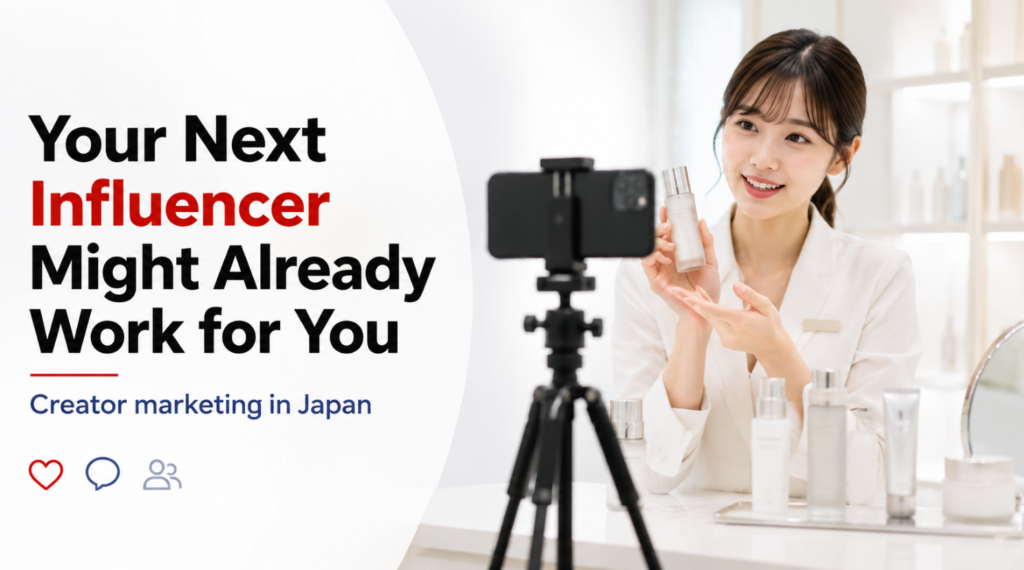
Through its Omni PBP initiative, the Japanese beauty company helped existing beauty advisors become digital creators. The case raises a question that many businesses overlook: could the next person to influence your customers already work inside your company?
Why Creator Marketing Matters for Overseas Brands Entering Japan
Creator marketing was once closely associated with sponsored posts from celebrities and lifestyle influencers. Brands selected people with established audiences and relied on them to introduce products to potential customers.
That model remains highly relevant. External influencers can help overseas companies reach Japanese audiences, build awareness, and present products through voices that local consumers already recognize.
They can also provide important cultural context. A Japanese influencer may understand how consumers discuss a category, which product benefits require more explanation, and why a message that succeeded elsewhere may not feel convincing in Japan.
However, Japan’s creator economy now extends beyond conventional influencer campaigns.
Consumers also follow specialists, educators, professionals, and enthusiasts who consistently provide useful information. A creator’s value may come from reach, but it can also come from practical experience, communication ability, or a strong understanding of a particular subject.
Research from the Creator Economy Association of Japan highlights the growing importance of the person behind the content. Audiences may follow and support the same creator across several platforms because they value that individual’s knowledge, perspective, and ongoing activity.
This gives brands a more useful starting question:
What do Japanese customers need to understand, and who is best placed to explain it?
In many cases, the answer will still be an external influencer. In others, the relevant knowledge may already exist inside the business.
How Shiseido Found Influencers Inside Its Own Organization
Shiseido, one of Japan’s largest cosmetics companies, refers to its beauty advisors as Personal Beauty Partners, or PBPs.
These employees traditionally work directly with customers in stores. They recommend skincare and cosmetics, demonstrate makeup techniques, and help people choose products based on individual needs.
During the COVID-19 pandemic, Shiseido began considering how its beauty advisors could continue building customer relationships beyond physical retail. The company wanted to extend their role through digital channels rather than keep their expertise limited to the sales floor.
In 2021, it began developing digitally focused beauty advisors known as Omni PBPs.
According to the Web担当者Forum case study, Shiseido used an existing internal talent exchange program, originally designed to give beauty advisors experience in different types of work, and invited employees to apply.
By 2024, the initiative had grown to around 50 participants. Omni PBPs created content for Instagram, TikTok, YouTube, and X. They also appeared in livestreams and provided online beauty consultations. Several participants developed audiences of more than 100,000 followers.
Those numbers are notable, but the more useful lesson lies in how Shiseido found its creators.
The company did not begin with popular influencers and teach them about its products. It began with knowledgeable beauty advisors and helped them develop digital communication skills.
For overseas companies entering Japan, the lesson is not to reproduce Shiseido’s structure. It is to examine whether local employees, distributors, retail partners, sales teams, or technical specialists already possess knowledge that Japanese customers need.
When Employee Expertise Becomes Influencer Content
Shiseido’s beauty advisors already understood the questions customers asked, the differences between products, and the concerns that made people hesitate before buying.
That experience gave them a strong foundation for digital content.
A skincare video needs to explain information clearly. A makeup tutorial must make techniques easy to follow. A livestream host has to answer individual questions while keeping the discussion useful for everyone watching.
Shiseido used each beauty advisor’s knowledge as the basis for their content. At the same time, it did not require every participant to use the same personality, subject, or format.
Some Omni PBPs became known for realistic makeup demonstrations. Others attracted followers through livestreaming, product education, or advice focused on specific beauty concerns.
The aforementioned article explains that Shiseido deliberately avoided giving overly detailed instructions. The company believed excessive direction could make participants passive and weaken the enthusiasm behind their content.
This freedom appears to have supported the initiative. Participants could draw on their professional experience while developing a voice that felt recognizably their own.
Their expertise gave customers a reason to trust the content. Their individual styles gave audiences a reason to keep following.
The same principle can apply beyond cosmetics. A consumer electronics specialist can compare product features. A chef can demonstrate ingredients or equipment. A hotel employee can share recommendations based on daily experience. An engineer can explain why a product was designed in a particular way.
This can be particularly relevant in Japan, where customers often compare products carefully and look for detailed information before purchasing. In beauty, technology, food, hospitality, and B2B services, practical guidance can be as important as initial awareness.
How to Find Potential Influencers Inside Your Company
Shiseido recruited Omni PBPs through an internal application process rather than assigning the role to employees selected by management.
For other businesses, the first step is to identify where customer knowledge already exists. Employees in retail, sales, customer service, product development, technical support, training, and consulting may understand customers in ways that are not immediately visible to the marketing team.
Strong internal candidates usually combine three qualities:
- Detailed knowledge of the product, service, or category
- The ability to explain that knowledge clearly
- A genuine interest in creating content and communicating publicly
The best employee creator is not necessarily the most senior expert or the most confident person in the office. Companies should look for people who can translate experience into communication that customers find useful.
Shiseido’s use of an existing talent exchange program also provides a broader business lesson. An internal creator initiative does not always need to begin as an isolated social media project. It may fit naturally within employee development, internal mobility, or cross-functional training.
A related approach in Japan is Naka-no-Hito marketing, in which an employee or internal team gives a corporate social media account a recognizable human voice. It is a different model, but it also shows how companies can strengthen communication by using talent already inside the organization.
Why Running the PDCA Cycle Internally Matters
An internal creator program can offer more than a new source of content. It can also give the company a system for learning from that content continuously.
According to MarkeZine, Shiseido’s Omni PBPs receive training, review results, exchange ideas, and share successful approaches. Participants who need additional support can also receive feedback on how to improve their content.
This allows the team to manage the PDCA cycle internally:
- Plan: Choose themes based on customer interests and business priorities.
- Do: Create and publish content.
- Check: Review performance data and audience responses.
- Act: Apply the findings to future content.
When creation, analysis, and improvement remain inside the company, each post can inform the next one.
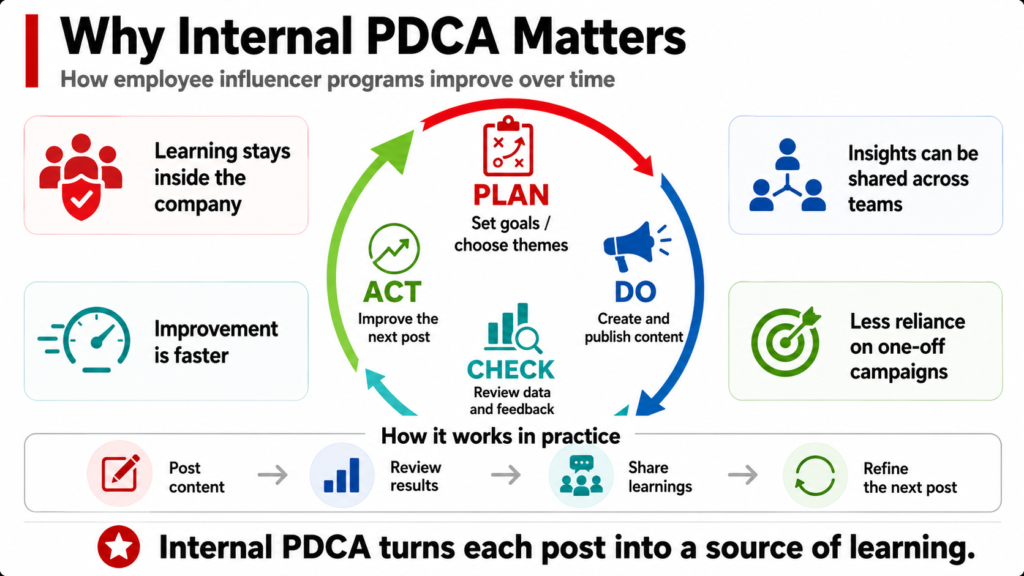
The team can see which topics attract attention, which formats work for different audiences, and which explanations respond to real customer concerns. Successful approaches can then be shared across the organization rather than remaining with one individual.
This is particularly valuable for overseas companies entering Japan. Local customer knowledge is rarely built through one campaign. It develops through repeated observation, testing, and adjustment.
External partners can provide reach and cultural insight. An internal PDCA process helps the company retain what it learns and apply those insights to future marketing.
How Overseas Brands Should Choose Influencers in Japan
External and employee influencers bring different strengths to a Japan marketing strategy.
External influencers may be more suitable when a company needs:
- Fast awareness
- Access to new audiences
- Cultural or lifestyle relevance
Employee influencers may be worth considering when a company needs:
- Product education
- Expert-led content
- Ongoing customer support
An established Japanese influencer can introduce an overseas brand to a relevant audience and present it within a familiar cultural context. An employee with specialist knowledge can answer detailed questions and support customers as they compare options.
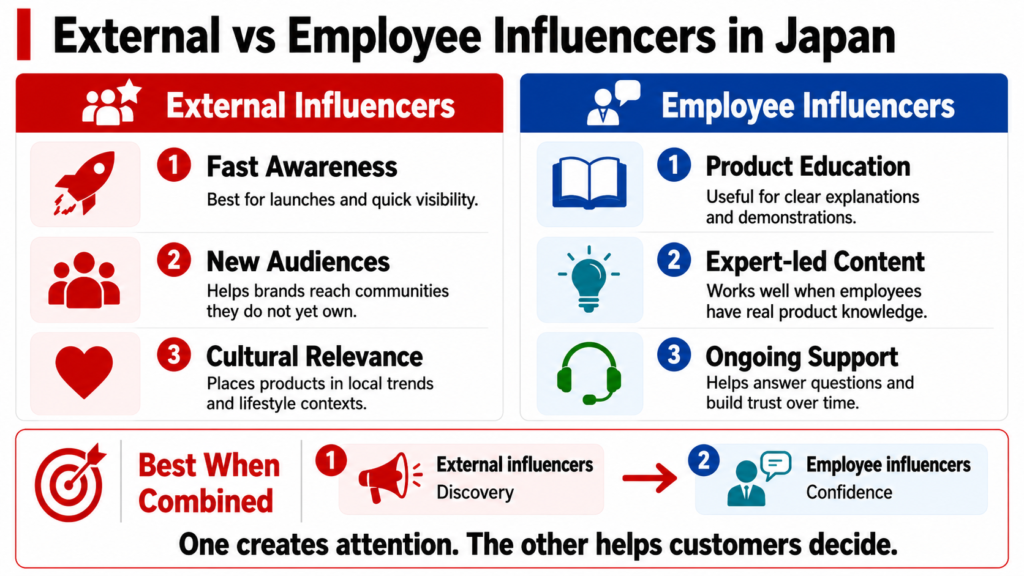
For many businesses, the strongest strategy will combine both.
External influencers can create attention and discovery, while employee influencers can build understanding and confidence.
The right balance depends on what the brand needs customers to do next. Companies should define the role of the content before deciding who is best placed to create it.
Could Your Next Influencer Already Work for You?
Before beginning an external search, overseas companies should consider three questions:
- What does the business need the content to achieve?
- What information do Japanese customers need?
- Does the right expertise already exist inside the company or its local network?
The business objective should come first. The influencer should come second.
The answer may be an external Japanese influencer, an employee creator, a distributor, a local specialist, or a combination of these options. What matters is choosing the people who are best suited to the role the content must perform.
The next influencer your company needs may already understand your products, customers, and the questions behind a purchase better than anyone outside the business.
JDOC helps overseas companies evaluate these options through Japanese market research, localization, influencer and creator strategy, social media marketing, and go-to-market planning.
Rather than recommending the same model to every business, we help companies decide which people, platforms, and content formats are most likely to build trust with Japanese customers.
To discuss the right influencer and creator marketing strategy for your business, contact JDOC.
FAQ
What is an employee influencer?
An employee influencer is a staff member who creates public-facing content based on professional knowledge, customer experience, or product expertise. This may include tutorials, product demonstrations, livestreams, social media posts, or answers to common customer questions.
Should overseas brands use employee influencers in Japan?
They can be effective when local employees or specialists already understand the product and the questions Japanese customers ask. However, overseas brands may still need external Japanese influencers when the priority is reach, cultural relevance, or rapid awareness.
Are employee influencers better than external influencers?
No. They usually serve different roles. External influencers are often stronger for attention and discovery, while employee influencers can support understanding and confidence.
Can employee and external influencers be used together?
Yes. For many brands, this is the strongest approach. An external influencer can introduce the product to a relevant audience, while an employee influencer can provide deeper explanations and help customers make a decision.
Which industries are most suited to employee influencers?
The approach is especially relevant in industries where customers need detailed explanations or practical guidance. Examples include beauty, technology, automotive, hospitality, food, fitness, retail, and B2B services.
Can a company without employees in Japan use this approach?
Possibly. The relevant expert may be a distributor, retail partner, trainer, consultant, or local representative rather than a direct employee. The important point is that the person has credible knowledge and a clear relationship with the brand.
Why is an internal PDCA cycle important?
It helps the company retain what it learns from content performance. Teams can review results, share successful approaches, and improve future content instead of treating each campaign as a separate activity.
How can JDOC help?
JDOC helps overseas companies evaluate whether employee influencers, external creators, or a combined approach is most appropriate for the Japanese market. This includes market research, localization, creator selection, social media strategy, and campaign planning.
Sources
- Web担当者Forum, Shiseido’s Omni PBP Initiative
- Creator Economy Association of Japan, 2025 Survey of Japan’s Creator Economy
- Mitsubishi UFJ Research & Consulting, Survey Results on Japan’s Creator Economy, 2025
- MarkeZine, Why Shiseido’s Employee Influencer Strategy and PDCA Cycle Succeeded
- JDOC Insights, Naka-no-Hito Marketing: How Japanese Brands Build a Human Voice