For overseas companies entering Japan, LINE can be easy to misunderstand.
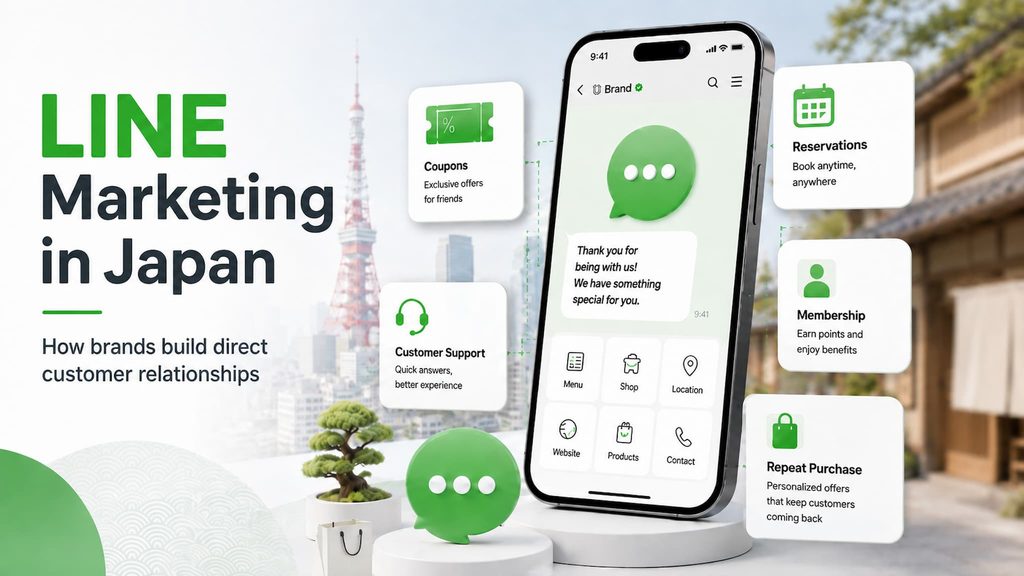
At first glance, it looks like a messaging app similar to WhatsApp. In practice, however, Japanese businesses use LINE for far more than private communication. The platform can support customer service, coupons, reservations, loyalty programmes, membership cards, ecommerce, repeat purchases, and even the management of subscription services.
As of March 31, 2026, LINE had 100 million monthly active users in Japan, equivalent to 81.3% of the population. Its scale and everyday use make it one of the most important digital platforms in the country.
LINE’s value to marketers extends far beyond its massive audience size.
Unlike Instagram, TikTok, X, or YouTube, LINE is usually not the place where an unfamiliar brand is first discovered. A customer may initially encounter a company through social media, search, advertising, PR, reviews, or a physical store. LINE often becomes more valuable after that first contact, when the company wants to maintain the relationship through membership, customer support, reminders, offers, or repeat purchases.
In this article, we cover the key principles of LINE marketing in Japan, explain how the platform differs from other digital channels, and examine how successful brands use it to build lasting customer relationships.
What Is LINE Marketing in Japan?
What Is LINE?
LINE is a messaging and communication app launched in Japan in 2011. Today, it is operated by LY Corporation, the company created through the integration of businesses including LINE and Yahoo Japan.
At its core, LINE is used for everyday communication. People exchange private messages, participate in group chats, and make voice and video calls with friends, family members, colleagues, schools, and local communities. Because it is embedded in daily life, LINE occupies a different position from public-facing platforms such as Instagram, TikTok, X, or YouTube.
Consumers generally do not open LINE primarily to browse brand content. They open it because it is part of their normal communication routine. Businesses can enter that environment through LINE Official Accounts.
This is why describing LINE simply as “Japan’s WhatsApp” is incomplete. WhatsApp is a useful reference point, but LINE in Japan combines messaging with a wider set of business functions related to customer service, loyalty, promotions, membership, and connected digital services.
For marketers, it functions as a hybrid of messaging, email, CRM, loyalty software, and a lightweight brand app.
What Is LINE Marketing?
LINE marketing leverages LINE Official Accounts and integrated services to maintain customer relationships and drive actions like sign-ups, bookings, purchases, and customer support.
Once a user adds a business as a “friend,” the company can communicate directly with that person and provide access to useful functions. Typical uses include promotional messages, coupons, reservation reminders, customer-service chat, digital membership cards, loyalty programmes, delivery information, product notifications, and links to ecommerce or store services.
The objective does not always have to be an immediate sale. In many cases, LINE is most useful when it simplifies a recurring task or makes the wider relationship with the company more convenient.
What a LINE Official Account Can Do
A LINE Official Account can range from a simple messaging channel to a more integrated customer-service and CRM tool.
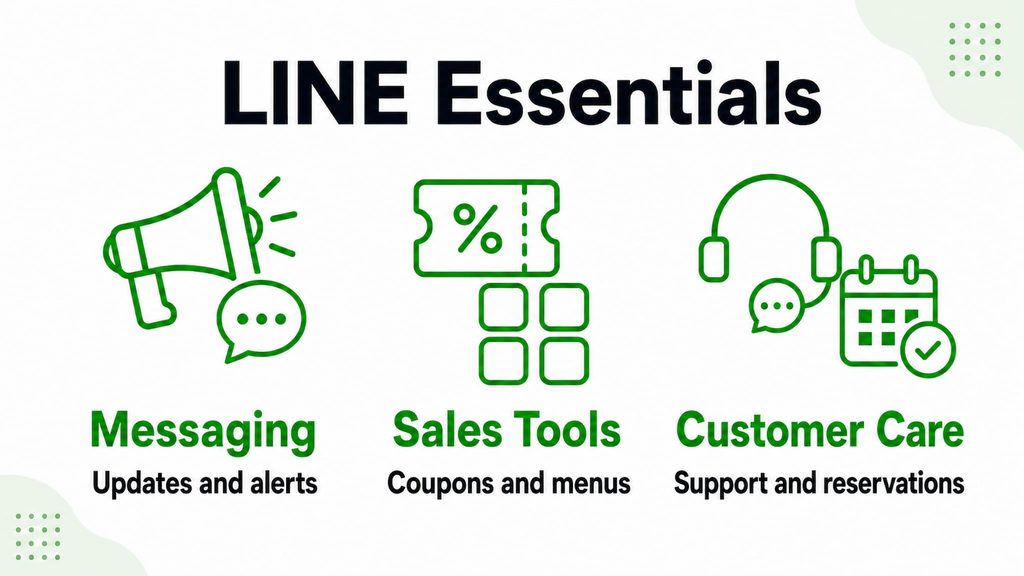
Common functions include:
- Messages and notifications: Product updates, reminders, and campaign information.
- Coupons and promotions: Digital offers that can encourage online purchases or store visits.
- Rich menus: Persistent buttons for actions such as “Shop,” “Membership Card,” “Reservations,” or “Find a Store.”
- Customer support: Chat-based assistance and quick access to service information.
- Membership and loyalty: Digital membership cards, points, and customer benefits.
- Reservations and services: Connections to booking, ordering, or other customer systems.
More advanced setups can connect LINE with ecommerce platforms, CRM databases, reservation systems, and membership data to make communication more relevant.
Beyond messaging, LINE serves as a practical interface for shopping, booking, customer support, and long-term engagement.
Where LINE Fits in the Japanese Customer Journey
Why LINE Is Stronger After Discovery
LINE is generally strongest when a customer already knows the brand and has a reason to stay connected. Consumers typically do not browse unfamiliar LINE Official Accounts in the same way they discover brands through Instagram, TikTok, X, YouTube, search engines, or online advertising. Instead, LINE is usually introduced later in the customer journey, after initial awareness has already been created.
A customer might first discover a cosmetics brand on Instagram, research its products through search and reviews, visit the website or store, and then add the company’s LINE account to access a membership card or receive future information. A restaurant customer might discover the business through Google Maps, visit once, and then add LINE to receive reservation information or future offers.
JDOC’s English guide to social media usage in Japan similarly positions LINE around communication, CRM, customer support, conversion, and retention rather than primarily around initial discovery.
How LINE Works with Other Marketing Channels
LINE makes more sense when viewed as part of a broader channel system. Instagram may create visual interest, YouTube may explain a complex product in detail, and search and reviews may help consumers validate a decision. PR and advertising may create awareness, while a physical store may provide the first direct experience with the product.
LINE can then help the company maintain contact after that first interaction. Its role is often to turn temporary interest into an ongoing customer relationship.
For foreign companies, this distinction is important. A large LINE user base does not mean that opening an Official Account will automatically generate awareness. The business still needs other channels to bring people into the customer journey. LINE becomes valuable when there is a practical reason for the customer to stay connected afterwards.
LINE Marketing vs. Email Marketing
When Email Works Better
LINE and email have an obvious similarity: both allow companies to communicate directly with people who have chosen to hear from them. However, the two channels are useful for different kinds of communication.
Email is generally stronger for information customers may want to read carefully, retain, search for, or return to later. Detailed newsletters, educational articles, long product explanations, receipts, corporate updates, and B2B communication all fit naturally into email.
Email also has an important structural advantage. Companies generally have greater control over their permission-based email databases and can move that data between service providers, subject to applicable privacy and marketing requirements. This makes email useful as a durable customer communication asset.
When LINE Works Better
LINE becomes especially useful when a customer needs to do something rather than simply read something. A customer may open LINE to display a membership card, redeem a coupon, confirm a reservation, check a delivery, find a store, contact customer support, or manage a subscription.
A rich menu can keep these actions immediately accessible, reducing the number of steps between communication and action. This convenience is particularly valuable on mobile, where even small amounts of friction can discourage completion.
There is also an important difference in visibility. LINE messages appear inside the same application people use for personal conversations. That can make them difficult to miss, but it also means poor communication can feel more intrusive. A promotional email may simply remain unread, while a repetitive LINE account may be blocked.
Rather than mirroring email schedules, LINE messages must deliver immediate value through convenience, relevance, and precise timing.
Why LINE and Email Should Complement Each Other
For many businesses, the strongest approach is not to choose one channel over the other. Email can provide depth, permanence, and database ownership, while LINE can provide immediacy and make recurring customer actions easier.
A company might use email to explain a new service in detail, while LINE provides the reservation link and sends a reminder shortly before the appointment. The distinction can be summarized simply:
While email excels at delivering detailed information, LINE is optimized for driving immediate customer action.
How Brands Build a LINE Audience
Where Customers Encounter a LINE Account
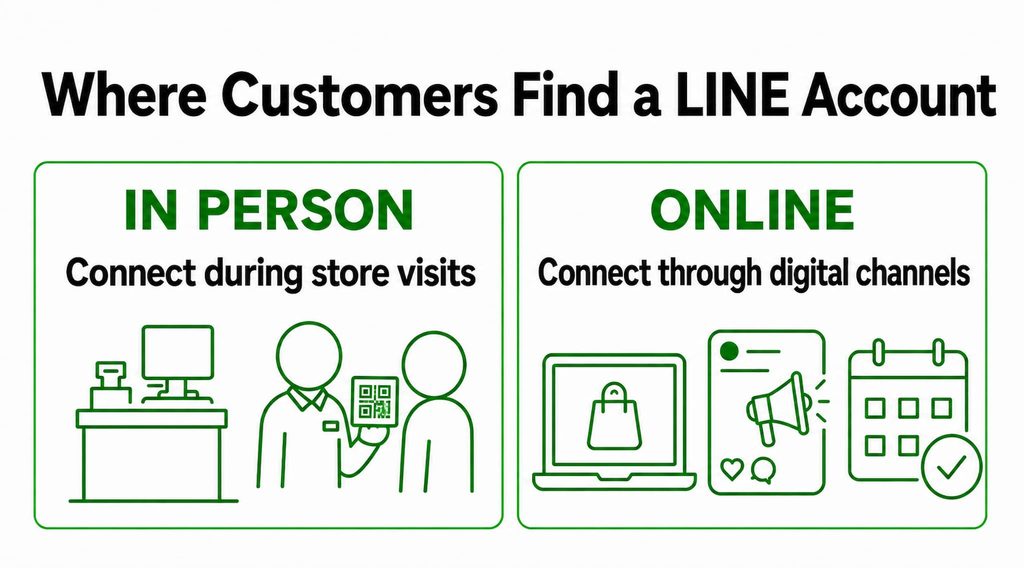
Businesses commonly acquire LINE friends through physical stores, websites, ecommerce, advertising, packaging, events, reservation flows, and social media. Physical retail can be particularly effective because the invitation appears while the customer is already interacting with the company.
A retailer might place a QR code near the checkout counter. A restaurant may include one on a menu or receipt. A beauty salon may introduce LINE while helping a customer arrange their next appointment. Digital entry points can include ecommerce pages, corporate websites, campaign landing pages, advertisements, reservation systems, and social media profiles.
However, where the QR code appears matters less than what the customer receives after scanning it.
Why Customers Need a Reason to Join
“Add us on LINE for updates” is not a particularly strong value proposition. A more practical reason might be access to a digital membership card, appointment reminders, delivery management, stock notifications, points, reservations, or customer support.
This changes the nature of the relationship. Instead of asking customers to accept more marketing, the company gives them a practical reason to remain connected.
Coupons can also encourage friend acquisition, but they have an obvious limitation. Some customers may add the account only to receive a discount and then block it afterwards. A large friend count can therefore look successful even when the long-term relationship is weak.
Why Customers Need a Reason to Stay
Friend acquisition and friend retention should be planned together. The welcome message should immediately explain what the account provides, while the rich menu should make its important functions obvious. Later communication should continue to deliver the value that encouraged the customer to join in the first place.
Instead of focusing solely on friend acquisition, markters should give customers compelling reasons to stay connected after claiming their initial incentive.
LINE Marketing Examples in Japan
L’Occitane Japan: Connecting Membership, Retail, and CRM
L’Occitane is a French beauty and personal-care company. Its Japanese operation provides a particularly useful example for foreign brands because it shows how localization can extend beyond advertising and product communication.
L’Occitane Japan introduced a digital membership card through its LINE Official Account, using the LINE Front-end Framework, commonly called LIFF. This gave customers a clear practical reason to add the account. They were not simply subscribing to promotional messages; LINE became part of their membership relationship with L’Occitane.
Physical stores were therefore an important acquisition point. Staff could introduce LINE while the customer was already making a purchase or interacting with the brand, when the benefit of registration was easier to understand.
By July 2020, approximately one million customers had connected with L’Occitane’s digital membership programme through LINE. The company could then use linked customer information to support more relevant CRM communication and ecommerce activity.
Rather than treating every LINE friend identically, communication could reflect differences between customers. A newer customer might benefit from introductory product information, while a repeat customer may be more interested in products related to categories they had purchased previously.
L’Occitane’s success lies in seamlessly connecting LINE with its membership program, physical stores, customer data, and e-commerce platform.
For overseas companies, this demonstrates a broader form of localization. Localization is often discussed in terms of language, creative, packaging, and product positioning, but companies may also need to localize how customers interact with the business.
That includes how they register, access benefits, receive support, and move between offline and online channels. L’Occitane maintained its international brand identity while adapting its customer relationship infrastructure to a platform embedded in Japanese daily life.
Asahi THE DRAFTERS: Building LINE into the Service
Asahi Breweries provides a very different model.
THE DRAFTERS is a membership-based service launched in 2021 that allows customers to enjoy draft beer at home using a dedicated beer server and recurring deliveries. Rather than developing the service first and adding LINE later as a promotional channel, Asahi incorporated the LINE Official Account into the customer experience from the beginning.
Customers could use LINE to access membership information, manage delivery dates, view instructional content, consult FAQs, and reach their member page. The rich menu could also change depending on whether someone was a prospective customer or an existing member.
That distinction matters because the needs of the two groups are different. A prospective subscriber needs information about the service, while an existing customer needs delivery management, instructions, and support.
Asahi also used chatbot interactions to collect information about customer preferences and drinking habits, helping make subsequent communication more relevant.
Rather than treating LINE as a mere promotional channel, Asahi made it a core interface for service management.
For other industries, this raises a useful question: Consider how LINE can eliminate friction from recurring customer interactions.
A hotel might use it for pre-arrival communication. A beauty business could use it for appointments and aftercare. A subscription company might use it for delivery management, while an education service could use it for class reminders and ongoing support.
The specific function will differ, but the underlying principle remains the same.
What These LINE Marketing Examples Teach
Give LINE a Clear Role in the Customer Journey
L’Occitane and Asahi represent two different strategic models. L’Occitane used LINE to strengthen an existing customer relationship system, connecting stores, membership, CRM, and ecommerce. Asahi incorporated LINE into the operation of the service itself, allowing customers to manage part of their ongoing subscription.
The common principle is more important than the individual tools. Neither business treated LINE simply as another place to publish promotional content. Both gave customers a practical reason to interact with the account.
This leads to one of the most important lessons for overseas companies:
Effective LINE strategies begin by identifying which customer actions the platform can simplify, rather than deciding what content to post.
Start with the Job, Not the Feature
That change in perspective affects the entire strategy. A retailer might decide that LINE should simplify membership. A hotel may use it to reduce friction before arrival. A subscription service could use it to make delivery management easier.
Only after defining that job should the business decide which LINE functions it needs.
Define the core business objective before selecting specific platform features.
How Foreign Companies Can Build an Effective LINE Strategy
Define the Customer Task First
A company should be able to explain clearly what customers are expected to do through LINE. A retailer may use it for membership and repeat purchases. A hotel may focus on booking reminders and pre-arrival support. A beauty company might use it for consultations, reservations, and store information.
If there is no clear reason for customers to add the account, the role of LINE probably needs more definition.
The experience after registration should also match that purpose. Someone who joined to access a membership card should be able to find it immediately. Someone who joined for reservations should not have to navigate through unrelated promotional content.
Use Segmentation to Improve Relevance
Not every customer needs the same communication. A recent purchaser may not need a first-purchase campaign, and someone in Osaka does not necessarily need information about a Tokyo-only promotion. A long-term member may also require different communication from someone who has just added the account.
Where appropriate systems, consent, and customer information are available, segmentation can make LINE communication more relevant. The objective is not to segment simply because the technology allows it. It is to reduce unnecessary messages and improve the usefulness of the relationship.
Measure Business Outcomes, Not Just Friend Count
Friend count is easy to understand and easy to report, but it is not always a meaningful indicator of business performance. The right metric depends on what LINE is supposed to achieve.
A membership-focused account may care about membership linking and repeat purchases. A restaurant might focus on reservations or store visits. A subscription service may care more about retention and account usage.
Blocking rate, coupon redemption, ecommerce conversions, and customer lifetime value may also be useful depending on the strategy.
The right KPI should reflect the job LINE was created to perform.
Is LINE Right for Every Foreign Brand in Japan?
When LINE Is Most Useful
No company should use LINE simply because the platform has a large audience. LINE is particularly relevant for businesses where customers have recurring reasons to interact with the company.
These may include retailers, restaurants, hotels, beauty businesses, healthcare services, membership programmes, subscription businesses, and companies with frequent customer-service interactions.
The common factor is not the industry itself. It is the presence of recurring customer tasks that LINE can make easier.
When Other Channels May Matter More
A B2B company with a long sales cycle may receive greater value from search, email, events, and direct sales. A business making mostly one-time sales with little need for after-sales communication may also have less reason to invest heavily in LINE.
The decision should depend on the customer journey, purchase frequency, need for repeat communication, offline interaction, membership structure, and the company’s available operational resources.
For businesses entering Japan with limited budgets, this distinction is especially important.
A sound strategy prioritizes channels that solve specific customer problems over mere presence on popular platforms.
How JDOC Can Support a LINE Strategy in Japan
JDOC supports overseas companies through Japan market research, localization, SEO, digital marketing, PR, influencer marketing, social media, and go-to-market strategy.
For businesses considering LINE, this includes determining whether the platform fits the customer journey in the first place, defining what role it should perform, and connecting it with other channels rather than treating it as a standalone communication tool.
Adopt LINE when it meaningfully enhances the customer experience in Japan, rather than simply following its market popularity.
For more information about developing a LINE marketing strategy for Japan, contact JDOC.
Frequently Asked Questions
Common Questions About LINE Marketing in Japan
What is LINE marketing in Japan?
LINE marketing is the use of LINE Official Accounts and related services to communicate with customers, provide support, manage memberships, distribute offers, facilitate bookings, and encourage repeat interactions.
What is a LINE Official Account?
A LINE Official Account is a business account that allows companies and organizations to communicate with users who add the account as a friend. It can support messaging, coupons, customer service, rich menus, and links to other services.
How is LINE used for marketing in Japan?
Businesses use LINE for direct messages, coupons, digital membership cards, reservations, loyalty programmes, customer support, delivery information, ecommerce links, and CRM communication.
Is LINE a social media platform?
LINE is commonly included in social media or SNS statistics in Japan, but its business role differs from public content platforms. It is generally stronger for direct customer relationships, service, conversion, and retention than for initial brand discovery.
Can LINE replace email marketing?
Usually not. Email remains useful for long-form communication and maintaining a permission-based customer database, while LINE can be more convenient for memberships, bookings, reminders, coupons, and customer support.
How do companies get customers to add their LINE Official Account?
Common entry points include physical stores, QR codes, websites, ecommerce pages, packaging, receipts, advertising, social media, events, and reservation flows. The strongest acquisition strategies provide customers with a clear practical reason to join.
Should foreign brands use LINE in Japan?
Foreign brands should consider LINE when direct communication, membership, reservations, repeat purchases, loyalty, or customer support are important to the customer journey. They should not adopt the platform simply because it has a large audience.
Sources
- LY Corporation, Business Development Outside of Japan
- LINE Yahoo for Business, LINE Official Account
- LINE Yahoo for Business, Rich Menu Documentation
- LINE Yahoo for Business, L’Occitane Japan: Digital Membership Card
- LINE Yahoo for Business, L’Occitane Japan: CRM and Segmented Messaging
- LINE Yahoo for Business, Asahi Breweries: THE DRAFTERS