
For niche brands entering Japan, achieving organic reach on Instagram is viable. The harder challenge is converting that reach into commercial demand. This report draws on JDOC’s management of the Japanese social media presence for a Norwegian Construction Toolmaker during its first 12 months in market, where two Reels generated 278K and 358K views without paid promotion.
It examines why the content gained traction, why follower counts understated its commercial value, and how JDOC connected organic reach to targeted advertising, e-commerce and trade show sales. For a broader overview of the local landscape, see our guide to navigating social media in Japan.
Key Findings
- Two Reels generated 278K and 358K views with no paid promotion. Both were built on a topic that earlier posts had already validated.
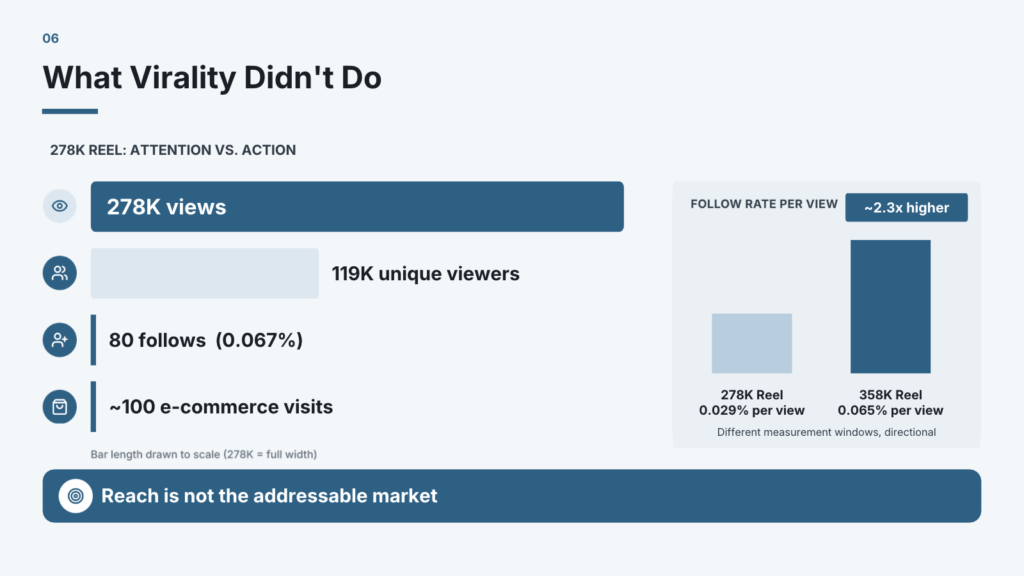
- Reach did not convert into follows at scale. The 278K Reel converted roughly 119K viewers into 80 follows, a rate of 0.067%.
- The 358K Reel generated 234 follows, roughly 2.3 times as many follows per view as the 278K Reel, though measured over a different window.
- The clearest commercial signals appeared off-platform: about 100 visits to the online store following the 278K Reel, repeated brand recognition at trade shows, and e-commerce sales up 30% compared with the same month of the previous year.
Two Reels, 278K and 358K Organic Views
The first Reel went live on October 21, 2026, generating 278K views in approximately 48 hours with no paid promotion. Cross-posted to Facebook, it drew about 162K views on Instagram (58.4% of the total) and about 116K on Facebook (41.6%).
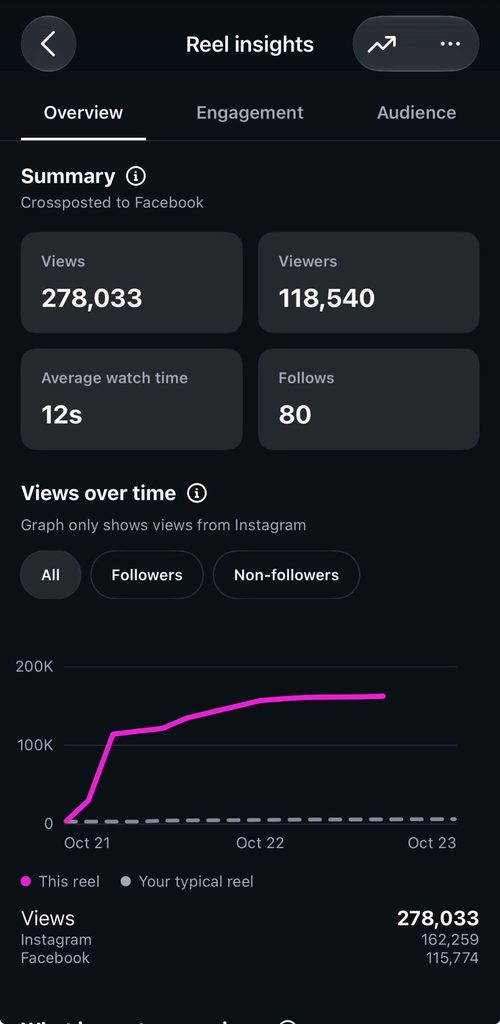
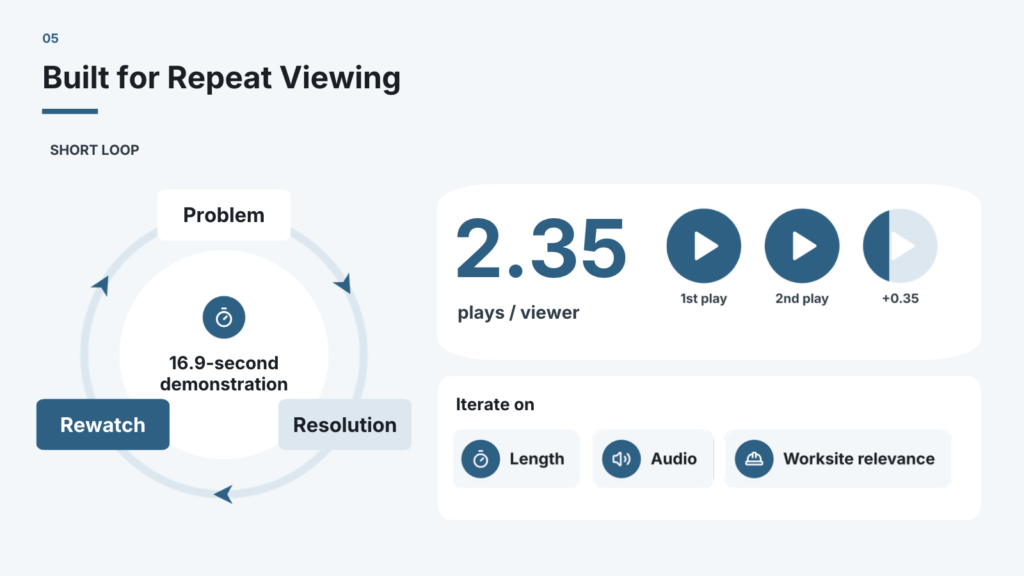
Viewing depth was strong. The Reel reached roughly 119K unique viewers, who averaged 2.35 plays each. Average watch time was 12 seconds on a 16.9-second video, or roughly 71% of its total runtime. This metric reflects average viewing duration rather than video completion rate.
A second Reel on the same account recorded 358K organic views and 234 follows, alongside 287 saves and 33 reposts, again with no paid support. Repeating a result at this scale suggests that the reach came from a repeatable creative approach rather than a one-off.
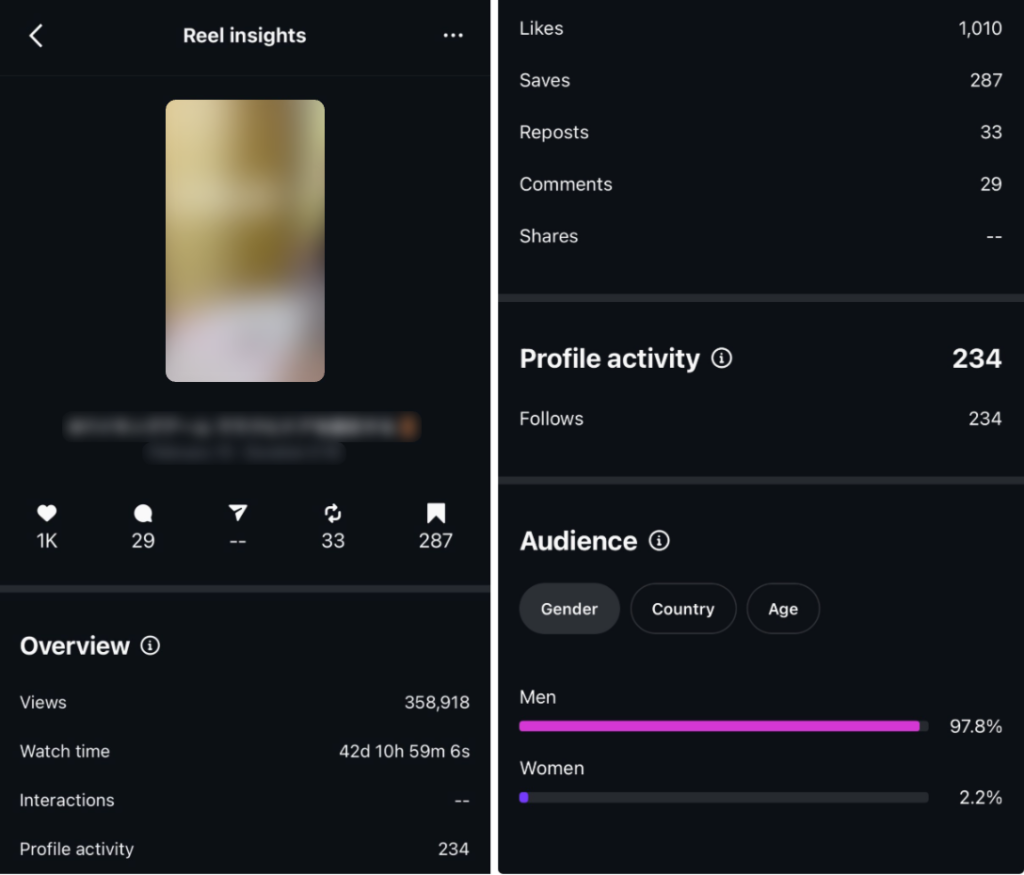
Because the two Reels were measured over different windows, their metrics are not directly comparable. What they share is more instructive: both opened with immediate motion, took place on a recognizable worksite and built toward a clear payoff. These are the creative choices we now treat as repeatable. The broader engagement with the Norwegian Construction Toolmaker is detailed in JDOC’s client work.
Why It Spread: Five Traits Behind the Reels
Both Reels focused on a single visual moment: a door brought into position and its hinge seating cleanly into place. Hanging a door requires precise alignment between the hinges on the door and frame, meaning even a minor adjustment produces a visible change. The footage turned a routine task into a compact, satisfying sequence that viewers could appreciate without prior brand awareness.
Our edit brought that moment to the forefront. Early motion, authentic worksite footage and Japanese narration anchored the action, while tight pacing carried viewers directly to the payoff. Five traits account for this performance.
1. A Payoff Within 20 Seconds
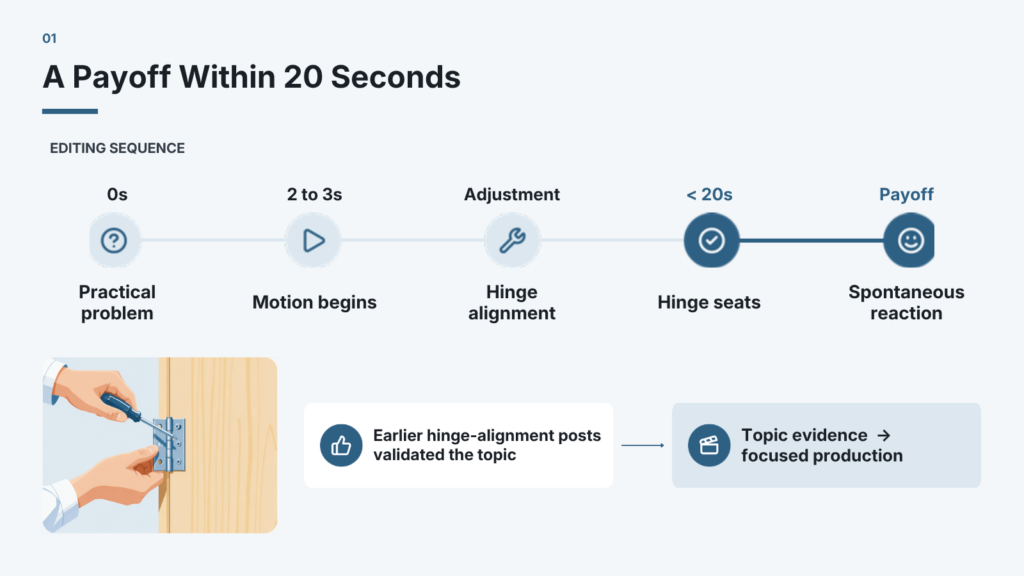
The satisfying moment anchored the entire piece: the adjustment worked, the hinge slipped into place, and a spontaneous reaction validated the outcome. Viewers could grasp what the tool accomplished without verbal explanation.
We introduced movement within the first two to three seconds and kept the sequence tight enough to reach the payoff in under 20 seconds. The practical problem grounded the action, while the precise fit and genuine human reaction made the clip compelling to watch.
Topic selection was data-led. Earlier posts addressing hinge alignment had already generated strong viewership, giving us clear evidence that the subject resonated with this audience before we committed further production effort.
2. A Worksite the Audience Recognizes
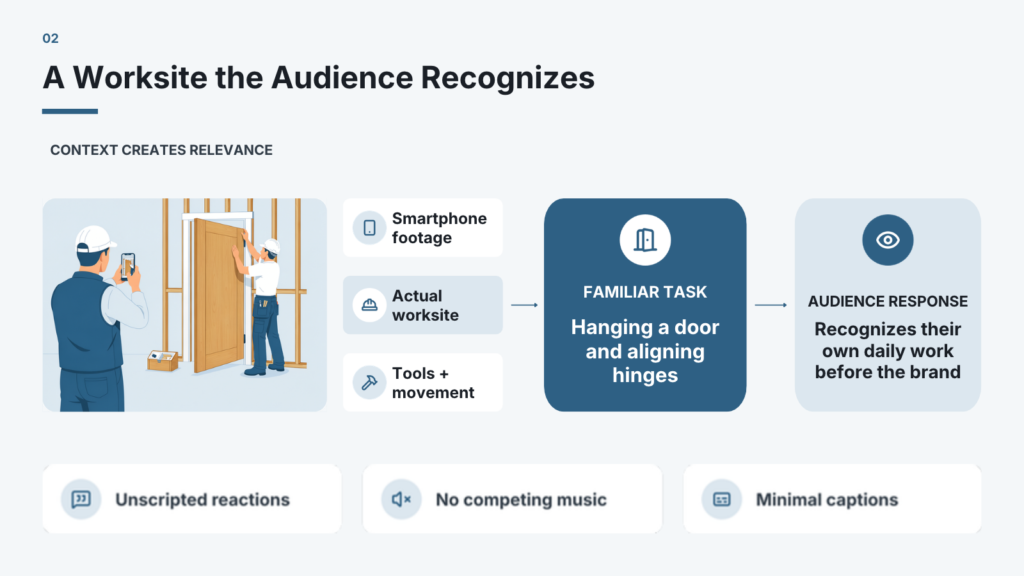
The Reel relied on smartphone footage of actual construction work, capturing the surroundings, tools and physical movements familiar to tradespeople on site. That authenticity allowed the target audience to connect the demonstration with their own daily work, while unscripted reactions reinforced credibility.
The core insight was that a recognizable situation can stop viewers before they know anything about the manufacturer. The worksite established that relevance in the opening seconds and placed the tool within a context the audience immediately understood.
Our editing preserved that authenticity. We avoided intrusive captions and music that would compete with the action, keeping focus on the original footage. This approach reflects the role of human presence in Naka-no-Hito marketing, a Japanese practice in which the people behind a brand make its communications more relatable.
3. Narration as a Tested Variable
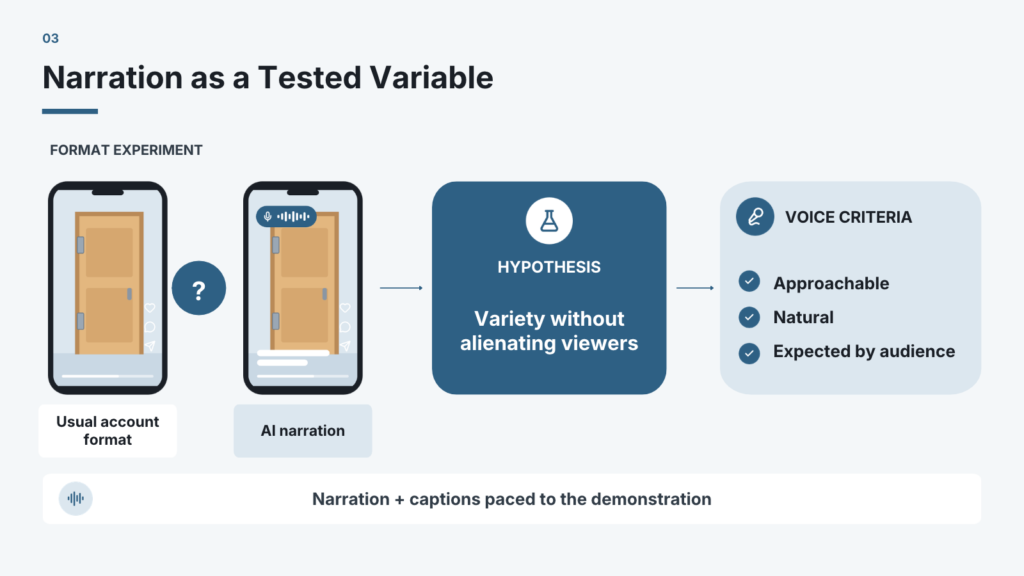
For this Reel, we deliberately tested AI narration as a departure from the account’s usual format. Our hypothesis was that a new delivery style could introduce variety without alienating the target audience, provided the voice matched their expectations. We selected the voice on that basis, prioritizing an approachable tone and natural vocal quality.
The Japanese narration and captions were paced directly to the demonstration, allowing viewers to follow the mechanics without diluting the payoff. The voice functioned as one element within the broader presentation, alongside phrasing and timing.
For overseas brands, the takeaway is that localization extends beyond translating a script. How a message sounds shapes how it is received. Vocal delivery is frequently overlooked, a pattern we examine in common localization mistakes on Japanese social media.
4. The Vocabulary of the Kaiwai
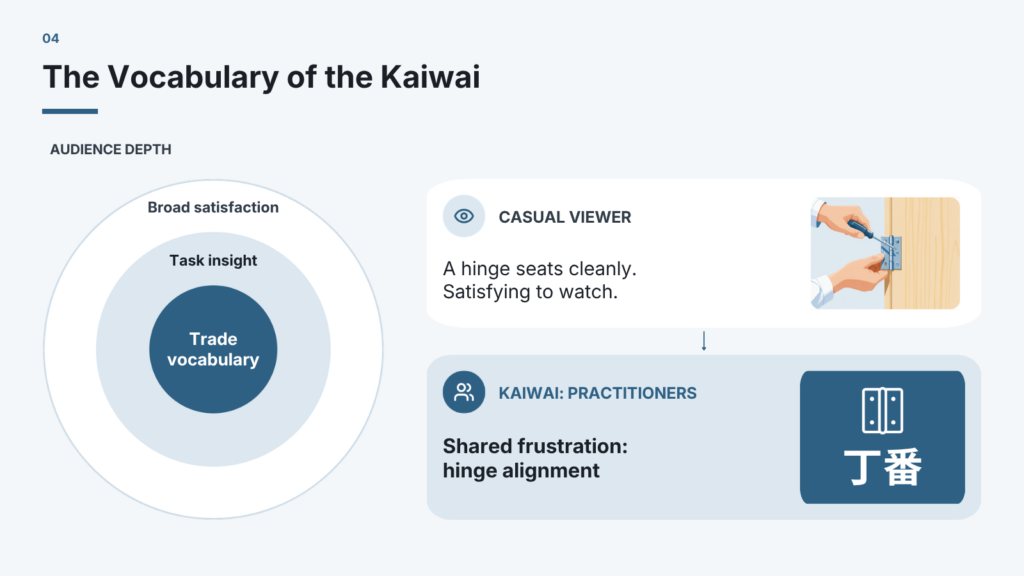
In Japanese, kaiwai refers to a community formed around a shared domain or interest. For this account, it represented practitioners with firsthand construction experience who intimately understood the small frustrations of tasks like hanging a door.
To a casual viewer, watching a hinge seat cleanly into place is simply satisfying. To someone who has wrestled with the same alignment issue, it demonstrates why the tool matters. The footage therefore carried a deeper layer of relevance for the people most likely to use the tool.
Using 丁番, the Japanese trade term for a hinge, reinforced that credibility by mirroring how the audience actually speaks on the job. For a niche overseas brand, precise industry vocabulary builds a stronger connection with the right buyers, even if it registers less with general audiences.
5. Built for Repeat Viewing
The demonstration ran 16.9 seconds and averaged 2.35 plays per viewer. Its concise structure allowed viewers to grasp the problem, see the resolution and rewatch with minimal friction.
Underperforming posts directly shaped these editorial decisions. Excessive length, poor audio and concepts disconnected from worksite realities all weakened performance. Optimal runtime must be established through iteration, as each product and demonstration requires a distinct level of explanation.
Publishing windows were equally deliberate. We posted around the end of the working day, when construction professionals are most likely to have time to watch. Timing alone cannot manufacture engagement, but it aligned distribution with the daily schedule of our target audience.
Taken together, these choices gave viewers a reason to pause, recognize the context and stay for the payoff. The more pressing strategic question was how much of that attention converted into lasting commercial interest.
What Virality Didn’t Do
The 278K Reel reached roughly 119K viewers yet yielded just 80 follows, a follow rate of 0.067%. While the content clearly captured attention, the overwhelming majority of viewers opted not to receive ongoing updates from the brand.
Comparing this with the second Reel is instructive. Measured per view, the 358K Reel generated follows at a rate of 0.065%, versus 0.029% for the 278K Reel, roughly 2.3 times higher. Because the measurement windows differ, this comparison is directional rather than conclusive. Even so, it indicates that follower conversion depends less on gross reach than on how much of that reach lands with people who genuinely need the product.
For a niche construction toolmaker, this distinction is critical. A satisfying visual demonstration appeals to broad audiences who will never buy the product, and passive entertainment is fundamentally different from commercial need. View counts measure the reach of the creative, not the size of the addressable market. We explore this dynamic in our analysis of why viral buzz does not always drive sales.
The account’s long-term value rests on serving professionals who use, or are evaluating, these tools. Maintaining that focus builds an audience with sustained interest in the products, even when individual Reels circulate far beyond the core market.
Some commercial intent also bypassed the follow button entirely. Following the 278K Reel, we tracked about 100 visits to the brand’s e-commerce site, suggesting that some viewers sought out product details regardless of whether they followed the account.
The next priority was capturing that intent through targeted advertising and a clear path to product information and purchase.
Organic and Paid as One System
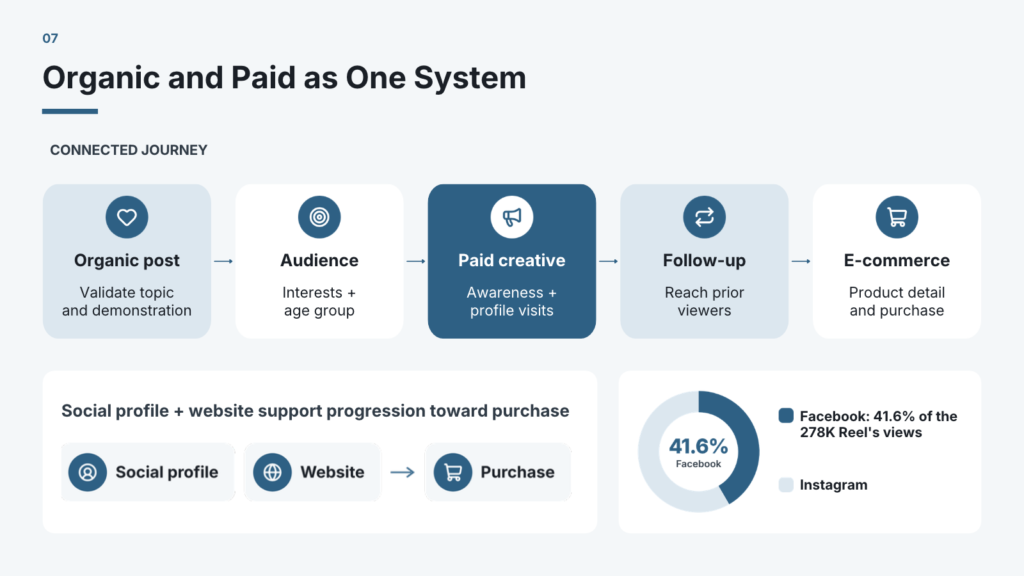
For a niche brand in Japan, organic content and paid media perform best as an integrated system: proven organic posts become ad creative, ads extend them to relevant audiences, and interested viewers are guided toward e-commerce. Organic performance reveals which topics and demonstrations command attention, giving paid media an evidence-based foundation.
For the Norwegian Construction Toolmaker, we began by defining the target audience by interests and age group, then selected keywords and messaging tailored to that profile. Campaigns optimized for awareness and profile visits established the baseline, with platform mix and targeting calibrated to each piece of content.
Within this operating model, a validated post transitions directly into ad creative, and follow-up ads can reach people who have already watched it. Subsequent touchpoints give viewers a reason to dig deeper through further demonstrations, more detailed product information or a direct visit to the online store. Both the social profile and the website must then support that progression toward purchase.
Platform selection forms part of the same discipline. Facebook delivered 41.6% of the 278K Reel’s views, a substantial share for this category. Some of the target audience may be more active on Facebook, while others rely primarily on Instagram. Our guide to how Japanese users split across platforms provides broader context for calibrating that mix.
Across the broader account, cost per follower held at around ¥100 for roughly the first 1,500 followers. How far that efficiency scales depends on the total size of the addressable market. The account reached 1,000 followers in four months and more than 2,000 in eight months, demonstrating steady audience growth beyond isolated viral spikes.
For suitable product categories, creators provide another credible setting to demonstrate practical utility. Our guide to working with Japanese influencers details the planning required, and JDOC’s influencer marketing service outlines how we integrate creator partnerships into a broader market entry strategy.
What the Account Did Offline
Instagram, with Reels cross-posted to Facebook, serves as the brand’s sole awareness channel in Japan. Because no parallel marketing activity runs alongside it, the account’s impact is unusually easy to isolate, and it shows most clearly at trade shows.
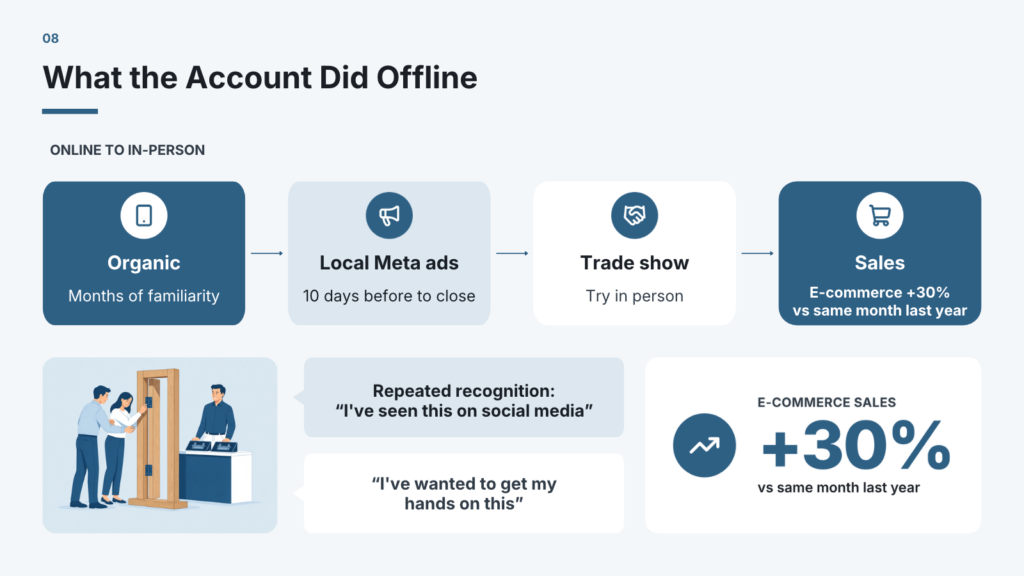
At major construction industry trade shows where we staff the brand’s booth, visitors we had never met told our team they had seen the product on social media and wanted to try it in person. Remarks such as “I’ve seen this on social media” and “I’ve wanted to get my hands on this” surfaced repeatedly. For an overseas brand in its first 12 months in Japan with no other promotion, this signals meaningful recognition within the industry. The evidence is qualitative rather than a tracked metric, but the pattern appeared consistently.
We amplify this offline momentum with targeted paid media. Around each trade show, we run Meta ads targeted to the area around the venue from 10 days before opening until the show closes, ensuring likely attendees encounter the brand’s best-performing content before they arrive. Organic activity builds familiarity over months, while local ads concentrate that awareness where the brand meets buyers face to face.
The recognition is also reflected in sales. E-commerce sales were up 30% compared with the same month of the previous year. For a specialist tool, trade shows provide what digital channels cannot: the opportunity to handle the product before purchase.
This explains why follower count understates the account’s true value. The 278K Reel generated only 80 follows, yet working professionals recognized the brand in person, and some of them went on to buy.
Will This Work for Your Brand?
Based on JDOC’s experience, this model is most effective for products with a distinctive appearance, strong design or clear visual appeal. These attributes give viewers an immediate reason to notice a product before they recognize the brand. For the Norwegian Construction Toolmaker, traction stemmed from a practical demonstration and its clear visual payoff.
| Factor | Stronger fit | Weaker fit |
|---|---|---|
| Visual appeal | Value is visible in a short demonstration | Value depends on lengthy explanation |
| Price and purchase route | Lower price with a simple path to online purchase | High price sold only online |
| Physical touchpoint | Trade shows, retail or another place to try the product | No way to handle the product before buying |
| Timeframe | At least one year organic, or about six months with ads | Expecting results within weeks |
Price point and purchase path govern how attention converts into revenue. A lower-priced product offers a more direct path from social discovery to an e-commerce purchase. Higher-priced items typically require buyers to inspect or handle them first, making a physical retail location or another place to experience the product an important complement to online sales.
The weakest fit is a high-priced product sold exclusively online when buyers need to evaluate it in person. In that scenario, additional social reach alone may leave a gap in the buying journey. We examine this alignment between social activity and the wider business in why social media strategies in Japan fail for foreign brands.
Planning horizons must also remain realistic. Our planning estimate is at least one year for organic-only operation, or around six months when advertising is added. These are experience-based planning assumptions rather than guaranteed timelines.
For overseas entrants, the starting point is to assess visual appeal, price and available sales channels together. That diagnostic determines how social media should support the broader Japan entry strategy and what capabilities a local partner must deliver. Our guide to choosing a social media agency in Japan outlines how to evaluate that support.
These two Reels demonstrate that a niche product can capture substantial attention in Japan. Converting that attention into sustainable revenue requires disciplined execution across audience targeting, paid media and the purchase journey. To evaluate whether this model fits your category, book a free consultation with JDOC.
FAQ
Does Instagram or X matter more in Japan for a small brand?
This case supports Instagram and Facebook for products whose value can be demonstrated visually. It does not establish a universal platform rule for every category. For a contrasting perspective, see how virality works on X in Japan.
Should we start with organic content or ads?
Design their roles as a single system. Organic posts identify which topics and creative angles resonate with the market. Paid advertising provides controlled distribution and prompts qualified viewers to investigate the product further.
How long until we see results?
Our planning estimate is at least one year for organic-only operation, or around six months with advertising. These are experience-based planning assumptions rather than guaranteed timelines for reach or revenue.
Do we need Japanese creators or native editors?
An on-camera Japanese creator was not required for this production. Native Japanese editorial judgment was critical in shaping the narration, industry terminology, captions and pacing. AI narration served as an execution tool supporting those editorial choices.
Can a niche B2B-leaning product reach consumers this way?
These two organic results show that specialist construction content can attract broad general viewership. The commercially relevant segment is narrower, making product education, targeted advertising and an accessible purchase path essential to monetizing that interest.
Data and Methodology
This report draws on JDOC’s firsthand management of the Norwegian Construction Toolmaker’s Japanese social media account. It incorporates native Reel Insights, JDOC’s internal case documentation and operational observations across content production, paid media and account growth.
Because the two Reels were measured across different timeframes, comparisons between them remain directional. Trade show feedback reflects qualitative field observations.
About the author
CEO & Co-founder, JDOC
Leo Hirata is CEO and co-founder of JDOC, a Tokyo-based marketing company that runs influencer, social and go-to-market campaigns in Japan for overseas consumer brands, and takes Japanese brands abroad. Before JDOC he worked at SAP, BASF and Audi Japan, and trained as a Japanese-German simultaneous interpreter (graduate degree, Heidelberg University). He has grown a Japan-focused Instagram account to 150,000+ followers in six months with no ad spend, and writes here about what actually happened in the campaigns JDOC runs.