
How to Work With Japanese Influencers: What BOTANIST’s Gifting Strategy Got Right
Influencer marketing is often treated as a media-buying exercise.
A brand selects creators based on follower count, agrees on a rate, and pays them to publish content. This can generate predictable exposure, but it does not always produce the trust required to turn a new product into something people genuinely want to try.
Product gifting works differently.
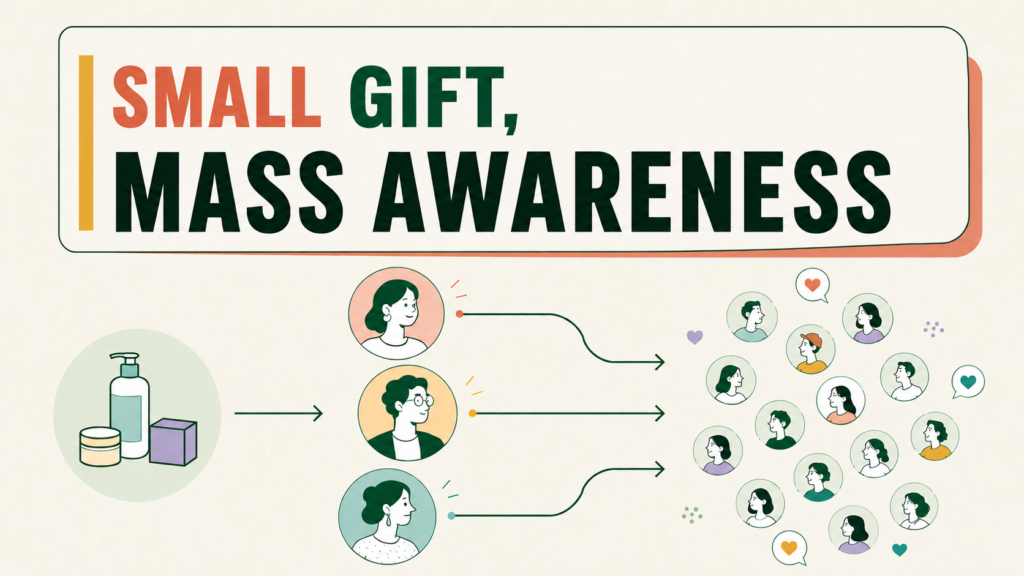
Rather than beginning with the largest available audience, a brand introduces its product to carefully selected people who are already trusted within the relevant category. If these insiders genuinely value the product, awareness can spread naturally through their professional and social networks.
Other creators may then discover the product through people whose judgment they respect. Models, celebrities or larger influencers may begin using and posting about it voluntarily. What starts as a relatively small gifting initiative can therefore develop into much wider consumer awareness.
The early growth of Japanese haircare brand BOTANIST provides a useful example. The brand did not initially depend on paid celebrity endorsements. Instead, it gifted products to hairstylists and fashion stylists with relatively modest follower counts but considerable influence within the beauty and fashion industries.
Their recommendations helped BOTANIST reach models and celebrities, some of whom reportedly began using and posting about it organically.
The case dates back to the mid-2010s, but the logic remains relevant. In a social media environment saturated with paid promotions, the right professional recommendation can still carry more influence than a much larger but less relevant audience.
What Is Strategic Product Gifting?
Product gifting is the practice of sending a product to selected professionals, creators or other influential individuals without necessarily purchasing a guaranteed post.
The recipient has an opportunity to experience the product but remains free to decide whether to mention it. This distinguishes genuine gifting from a conventional paid influencer campaign.
In a paid campaign, a brand normally agrees on specific deliverables, such as an Instagram Reel, TikTok video or YouTube integration. Compensation, timing, messaging and disclosure requirements are usually defined in advance.
With gifting, the brand is not purchasing a predetermined publication. It is creating an opportunity for discovery.
This makes the result less predictable, but it can also make a subsequent recommendation feel more credible. When someone chooses to use or discuss a product without being paid to produce a specific piece of content, the recommendation is more likely to be perceived as genuine.
However, sending free products to a long list of creators is not automatically a strategy. Effective gifting depends on selecting people who are relevant to the category and whose judgment is trusted by others.
The central question is not simply, “Who can show our product to the largest audience?” It is, “Who is most likely to understand our product and make the right people notice it?”
For foreign companies, answering that question can be difficult from outside Japan. Large creator accounts are publicly visible, but professional credibility and informal industry relationships are much harder to identify.
This is one reason translated global campaigns often struggle to gain local relevance. Effective localization requires an understanding of how Japanese audiences discover, evaluate and build trust in a brand—not simply Japanese-language captions. Our analysis of why social media strategies in Japan often fail for foreign brands explores this distinction in more detail.
The BOTANIST Model: From Trusted Insiders to Mass Adoption
BOTANIST is a Japanese personal-care brand developed by Osaka-based company I-ne. Launched in January 2015, it initially became known for shampoo and treatment products featuring plant-derived ingredients and minimalist white packaging.
At the time, Japan’s mass-market shampoo category was dominated by major manufacturers. Conventional product launches frequently depended on television commercials featuring well-known actresses or models, supported by magazine advertising and prominent drugstore displays.
BOTANIST took a different approach.
Rather than trying to compete through the same mass-media formula, it built the brand around Instagram and the broader concept of a “botanical lifestyle.”
According to a DIGIDAY Japan interview published in 2019, BOTANIST surpassed 50 million products sold by June 2018, approximately three and a half years after launch.
The article was sponsored by Instagram, so it should not be treated as independent evidence that the platform alone caused BOTANIST’s commercial growth. However, its interviews with I-ne executives provide a useful account of the brand’s early gifting and social media strategy.
Begin With Trusted Insiders
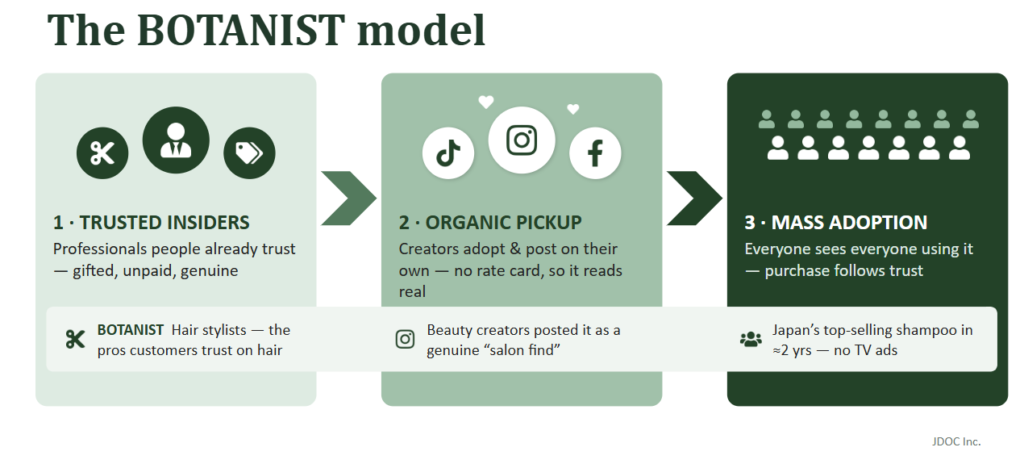
BOTANIST did not begin by paying celebrities or the largest beauty influencers to introduce the product.
I-ne first gifted its products to hairstylists and fashion stylists with whom it had already developed relationships through other brands.
Some of these professionals had relatively small public followings. According to I-ne, however, many stylists with modest follower counts still had considerable influence within the fashion industry.
A stylist may be largely unknown to the general public while working closely with models, photographers, editors and other visible figures. Their value therefore lies not only in how many consumers follow their account, but also in who listens to them within the industry.
This is the difference between visible reach and network influence.
Follower count shows how many people could potentially see a post. Network influence reflects who trusts the person and how their recommendation may travel through professional relationships.
By gifting its products to trusted industry insiders, BOTANIST placed the brand within a network where a recommendation could affect more than the recipient’s direct followers.
Create the Conditions for Organic Pickup
The product did not remain within the original group of hairstylists and fashion stylists.
Models and celebrities saw BOTANIST being introduced by these industry professionals, began using the products themselves, and posted about them voluntarily.
The models and celebrities were not necessarily the initial targets of the gifting strategy. They encountered the product through people whose professional judgment they already respected, and their posts subsequently introduced BOTANIST to much larger consumer audiences.
Celebrity visibility contributed to awareness, but the process began with the professional network that gave the product credibility. BOTANIST first reached the people who influenced the influencers.
This distinction is important because organic pickup cannot be purchased or guaranteed. A brand can only create favorable conditions by selecting relevant recipients, offering a product worth discussing and allowing people to respond in their own way.
If a brand needs a guaranteed post, publication date or specific message, the activity should be managed as a paid collaboration rather than unconditional gifting.
Turn Organic Pickup Into Mass Awareness
Organic pickup was only one part of BOTANIST’s growth.
When consumers encountered the brand through stylists, models or celebrities, BOTANIST’s official Instagram account gave them a coherent visual identity to explore.
Its content combined products with plants, interiors, natural light and understated lifestyle imagery. Instead of relying only on functional claims about moisture or damage repair, BOTANIST presented a broader botanical lifestyle.
The Instagram account functioned more like a visual lifestyle publication than a corporate announcement board.
Its minimalist packaging also connected online discovery with physical retail. Consumers who had repeatedly seen the bottles on Instagram could recognize them easily in a crowded Japanese drugstore.
This created a connected path from professional credibility to organic pickup, consumer awareness and purchase. The product was first introduced by trusted insiders, adopted by more visible figures and supported by a recognizable brand environment in which consumers could continue exploring it.
The broader point is that gifting, organic pickup, brand content and conversion should not operate separately. When they support one another, a small gifting initiative can become part of a scalable customer journey.
For a wider explanation of how creator activity, organic content and conversion should work together, see our guide to choosing a social media agency in Japan.
Where audiences actually spend their time shapes which of these signals get seen at all. Our overview of social media usage in Japan sets out the platform behaviour behind this.
Why the BOTANIST Model Still Works Today
BOTANIST’s early strategy dates back to 2015, and the social media environment has changed considerably since then.
Instagram has become more video-focused, TikTok has emerged as a major source of product discovery, and influencer marketing has developed into a much larger and more commercial industry.
The specific platforms and formats have changed, but the underlying logic remains effective.
Consumers now encounter sponsored posts, affiliate links, brand trips and paid collaborations every day. A paid creator campaign can guarantee exposure, but it cannot automatically guarantee credibility, product recall or purchase intent.
This makes genuine category authority especially valuable.
A professional with a modest following may still influence creators with much larger audiences. Their recommendation can feel relevant because it is supported by expertise and an established connection to the category.
The lesson from BOTANIST is therefore not that every brand should recreate an Instagram strategy from 2015. It is that a small, well-selected group can sometimes create more meaningful momentum than a large but poorly targeted creator list.
How Foreign Brands Can Apply Product Gifting in Japan
A foreign brand should begin by understanding the community around its category.
This means identifying who consumers trust, which professionals shape opinion and how products move between industry insiders, creators and the wider public.
The gifting list should not be based only on follower numbers. Category relevance, professional credibility, audience quality and relationships with other influential people may be equally important.
The product must also give recipients a genuine reason to care. Japanese professionals and creators receive large quantities of gifted products, and an irrelevant package accompanied by a generic message can easily be ignored.
The brand must then prepare for organic pickup.
If another creator, model or celebrity discovers the product, they should be able to find clear Japanese information, understand the positioning and see where the product can be purchased. A strong recommendation will lose much of its value if it leads to an untranslated account, an unclear website or a product that is difficult to buy.
Common Mistakes to Avoid
Reach is also not the same thing as demand. We looked at that gap in McDonald’s Japan vs. NISSIN, where viral posts on X did not translate into sales.
One common mistake is treating gifting as mass distribution. Sending the same package to hundreds of accounts may increase the number of deliveries, but it does not create professional relevance or genuine relationships.
Another is selecting recipients entirely through follower rankings. This can overlook insiders whose public audiences are small but whose influence within the industry is significant.
Brands should also avoid expecting guaranteed organic coverage. If publication, timing or messaging is required, the activity should be managed as a structured collaboration.
Japan has regulated stealth marketing under the Act against Unjustifiable Premiums and Misleading Representations since October 2023. Commercial content should therefore be disclosed appropriately when the relationship constitutes advertising.
Finally, gifting should not end with delivery. Without monitoring, localized content, product availability and a clear customer journey, even valuable organic attention may disappear without producing meaningful business results.
For further examples of how overseas campaigns can fail when applied directly to Japan, see 5 Ways Foreign Brands Crash and Burn on Japanese Social Media.
How JDOC Turns Product Gifting Into Organic Growth
If your product needs to be seen, tried or experienced before customers can fully understand its value, strategic gifting may be an effective way to introduce it in Japan.
However, successful gifting requires more than sending products to a list of creators. The product needs to reach the right people, the outreach must feel personal, and any organic pickup must connect with wider awareness and purchase.
JDOC supports this process from recipient selection to amplification.
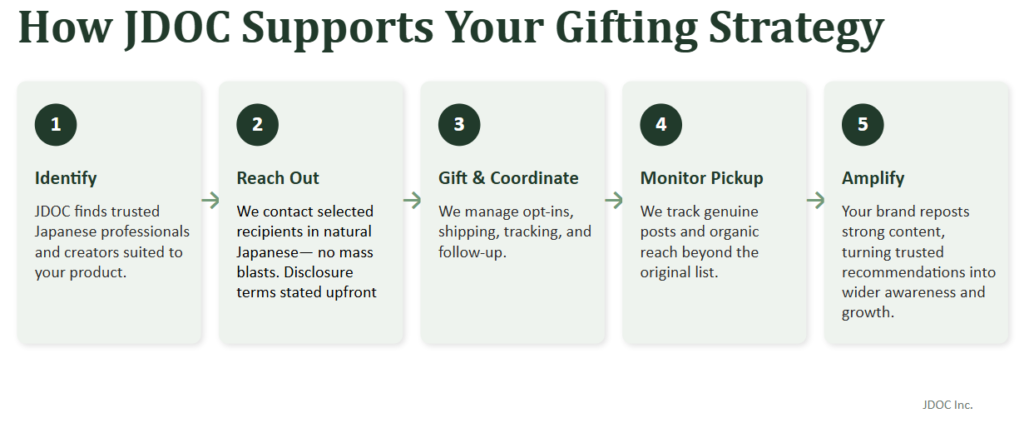
We identify trusted Japanese professionals and creators suited to your product, approach them personally in natural Japanese, and manage opt-ins, shipping, tracking and follow-up communication.
After delivery, we monitor genuine posts and look at whether the product travels beyond the original gifting list through organic pickup.
When strong content emerges, we can help coordinate permission for amplification. Your brand can then repost selected content through its own Japanese social media account, turning trusted recommendations into wider awareness, stronger social proof and growth.
The objective is not simply to distribute products or collect isolated posts. It is to help the right people discover the product, create the conditions for credible organic pickup and connect that momentum with a localized path to purchase.
If your product could benefit from trusted recommendations in Japan, contact JDOC to discuss whether strategic gifting should form part of your market-entry plan.
FAQ
What is the difference between product gifting and paid influencer marketing?
Product gifting introduces a product without guaranteeing publication. Paid influencer marketing involves a commercial agreement in exchange for defined content or other deliverables.
Does product gifting guarantee a social media post?
No. With genuine gifting, the recipient decides whether the product is relevant enough to share. If publication is required, the activity should be treated as a structured collaboration.
Can gifting lead to celebrity or major-creator posts?
It can, but this cannot be guaranteed. In the BOTANIST case, models and celebrities reportedly saw the product being introduced by trusted hairstylists and fashion stylists before using and posting about it voluntarily.
Can a brand repost content created through gifting?
Only with the creator’s permission. JDOC can help identify suitable content and coordinate permission so that your brand can repost it through its official account.
Can JDOC manage product gifting in Japan?
Yes. JDOC can identify relevant recipients, manage Japanese-language outreach and gifting coordination, monitor organic pickup and help your brand amplify suitable content with permission.
Sources
- DIGIDAY Japan, “Instagram Is Mass Media for Us”: BOTANIST’s Instagram Strategy, January 16, 2019.
- BOTANIST, Official Brand Website.
- Consumer Affairs Agency of Japan, Stealth Marketing Regulation Under the Act against Unjustifiable Premiums and Misleading Representations.